Showing posts with label beehives. Show all posts

Friday, December 21, 2012

BeekeepingDaily 12.21.2012: Catching up

Well, not so daily, is it, when I manage to skip a daily. Still trying to catch up. Enjoy two day's worth of beekeeping news in one from our friends at Google News alerts:


Web
Five-week, apprentice Master Beekeeper sessions slated for Everett
EVERETT, Wash. – A majority of the foods we eat depend on honeybees for pollination. Without healthy bee populations, our fruit and vegetables would be ...
news.wsu.edu/pages/publications.asp?Action=Detail...
Beekeeping at Isles | Isles, Inc.
Hopewell and Trenton Beekeepers Partner to Raise Bees in Downtown Trenton! Read More.
www.isles.org/features/beekeeping-at-isles


Web
Beekeeper from Israel
Shalom everyone, I am the Israeli beekeeping and hive products forum manager. I am new here and always looking to learn from beekeepers around the world.
www.beesource.com/forums/showthread.php?276642...p...
The Beekeeper's Bible by Richard A. Jones and Sharon Sweeny ...
[img]http://ecx.images-amazon.com/images/I/61sbXlxhxHL._SL500_AA300_.jpg[/ img] [size=18 ...
www.permies.com/t/.../Beekeeper-Bible-Richard-Jones-Sharon
Backwards Beekeepers: Getting a new beekeeper going
Michael is a new Backwards Beekeeper in LA. He and his wife Vinh have a great urban farm setup in Glassell Park with lots of happy chickens, vegetables, fruit ...
www.backwardsbeekeepers.com/.../getting-new-beekeeper-goi...


***

The spring-like weather that we have been having lately turned normal yesterday evening with some cold temperatures. They were ushered in by high winds that could have endangered the hives. Fortunately, when I got up this morning, everything was in tact. All the hives were still standing.

A blown-over hive is no fun for bees or beekeeper -- as anyone who has deal with one can attest.

I had to put one back together this spring, and while the bees had calmed down when I got to them, I knew they had gotten wet, which is the thing the bees hate the most.

I sometimes think about anchoring the hives and would certainly do so if high winds were a regular occurrence around here. They are not, and for that, I am thankful.
 

Monday, December 17, 2012

BeekeepingDaily: Dec. 17, 2012

A nice profile of Florida beekeeper Robert Bell is included in today's links:

  • Bell, who operates Bell Apiaries, said the reasons for the decline [of bees] are numerous and include pesticides, weather, an illness called Colony Collapse Disorder, and parasites that attach themselves to the bees and kill them. 

The latest from our friends at the Google alter system:

News1 new result for beekeeping
 
Beekeeper Buzzing to Battle Decline in Hives | NewsChief.com
News Chief
The likes of Fleetwood Mac, Don McLean and Jimmy Buffett subtly pipe through the stereo as he drives along roads outside phosphate mining areas, describing just what it is he does as a beekeeper and how important it is to the survival of agriculture.
See all stories on this topic »

Web1 new result for beekeeping
 
Beginning Beekeeping Course | Keokuk County
Beginning Beekeeping 8 week course to be offered at the Keokuk County Extension Office on Thursday evenings from 6pm to 8pm starting on January 17, 2013 ...
www.extension.iastate.edu/.../beginning-beekeeping-course

Friday, December 14, 2012

Settling in for winter, waiting to see what happens


The garden is plowed, the cold weather has begun, and the bees are -- mostly -- in the hives.

Cold weather in East Tennessee, of course, doesn't mean what it does in Nebraska or Vermont. We're waking up this December to some heavy frosts, with temps in the upper 20s at best, and then looking forward to early afternoon highs around 55 or 60.

So, to lots of folks, this ain't cold.

Still, it's the best we can do down here close to the Smokies, and we'll take whatever comes along.

We're down to six Langstroth hives and two topbars. The Langstroths appear to have plenty of bees, but I'm not so sure about the topbars. The Langstroths have plenty of feed on them at the moment, and we put some protein patties on the topbars, so we will see what happens.

That's what beekeepers do most of the time: wait to see what happens.

Would that it were otherwise, but one thing beekeeping teaches you is to take the long view. There have been years (too many) where there were no bees in the hives at all. The spring couldn't come soon enough in those sad seasons.

Now, however, I can take some comfort in the fact that I need a rest from the bees, and they undoubtedly need a rest from me.

We'll leave it at that right now, and continue to do what beekeepers do.


Here's how things look in the freshly plowed garden:


Monday, April 9, 2012

Easter around the farm

Here's a slideshow (with music from brother-in-law Frank) of what the day was like on the farm:

Sunday, January 8, 2012

Should the bees move to town?

There's an argument out there that bees are, in today's world, better off in urban areas than they are in the countryside.

 Supporters merely point to what Big Agriculture has done to the agricultural landscape: -- acres of just one or two crops (called monoculture) that don't offer the bees very much -- pesticides and herbicides

One of the people who makes that argument is Bryon Waibel, who runs the Her Majesty's Secret Beekeeper store in San Francisco -- a store, he says, is the only urban beekeeping store in the world. A video of Waibel talking about his store, and a longer story about it, has been produced by Fair Companies and is shown below.)


 "It would not surprise me at all if the future of beekeeping itself is in urban beekeeping," Waibel said. 

There is some logic to this argument, particularly when you think about how diverse urban and particularly suburban areas are in terms of flowers and other plants. There would be plenty for an enterprising bee to find in a well-kept neighborhood.

But there are problems as well, of course.

Pollution is the first thing that springs to mind. Another problem is acceptance. Many people do not understand bees and think they should be subjected to a can of Raid just like other insects.

 Still, Waibel's point about urbanites is a good one.

People in the city could get really interested in bees and become evangelists for them. A hive in a neighborhood might be just the tool to get people to see that having some bees around wouldn't be such a bad thing after all.

So, if bees are going to give up the country life and move to town, they have their work cut out for them. But, in the end, it might pay off for everyone.

Thursday, December 22, 2011

Happy birthday, Rev. L.


As Christmas closes in on us, beekeepers have another reason to note December 25. It is the birthday of Rev. Lorenzo L. Langstroth.

The inventor of the Langstroth beehive, the one that most of us use, was born on Dec. 25, 1810, in Philadelphia, Penn. From his earliest days, he took an interest in insects of all kinds, but interest lay dormant as he obtained his college education at Yale. After his graduation, he was a math tutor there for a couple of years and then became an ordained minister in the Congregationalist Church. His first pastorates were in Massachusetts. There he married Anne Tucker, and they had three children.

In 1848 he moved back to Philadelphia to become a principal of a young ladies' school, and there his interest in insects -- and specifically in bees -- revived.

Langstroth was meticulous and exacting in his pursuit. He read all of the latest writings on beekeeping, most of which were coming from Europe. The concept of bee space was well known there (Langstroth is often erroneously credited with having discovered it), but hives were not constructed to take full advantage of it. Langstroth did come up with the term "bee space" and set about re-thinking the design of the hive so that beekeepers could inspect the hive and extract the honey with, in his words, "enraging the bees."


In Europe, most hives were opened from the side. Langstroth combined the concept of bee space in a hive that could be opened from the top. In that way, the frames could be pried loose one at a time and taken out of the hive. This allowed the beekeeper to more easily manage the hive -- to check for problems, the prevent swarming, to replace a queen, and most of all, to extract honey. Langstroth knew what all of us beekeepers have come to know: bees spend most of their energy making comb. If the comb and be preserved and re-used, the amount of honey the bees will produce increases.

Langstroth applied for a patent for his hives in 1852. His description of the Langstroth hive makes fascinating reading.

But Langstroth never made any money off his invention. Instead, he became involved in a number of lawsuits trying to defend his patent from predators. His invention was quickly adopted by many beekeepers, and because North America is an ideal place for honeybees, the industry of beekeeping and producing honey quickly expanded.

Langstroth set down his observations about beekeeping in an 1853 book now known as The Hive and the Honey-Bee.

My wife recently gave me a copy of this book (which is still in print after more than 150 years) for our anniversary, and I was astonished by what I found when I sat down and started reading it. It is written in simple, straightforward language and so full of practical, modern advice that it is quickly becoming my favorite beekeeping book.

In the coming weeks, I plan to write some more about what I am finding out by reading Langstroth.

The reverend moved to Oxford, Ohio in 1858 and continued keeping bees. He became an advocate of using Italian bees, rather than the more popular European bees because of their productivity. He and his son made a profitable business out of selling Italian queens.

Langstroth lived on 10 acres in Oxford and had much of it planted with Linden and apple trees. He also sowed buckwheat and clover and filled his formal garden with bee-friendly flowers. He lived in Oxford for nearly 20 years before moving to Dayton to live with his daughter. He died in1895 on a Sunday morning when he was about to deliver a sermon at the Wayne Avenue Presbyterian Church in Dayton.

Tuesday, May 3, 2011

Varroa should be a constant in the beekeeper's plans

Varroa remains the most persistent and widespread threats to bees and bee colonies. No beekeeper in the world – except maybe in Australia where varroa has not yet invaded – can ignore this threat.


But knowing what to do about varroa is not easy. There are no standard procedures or treatments to rid a hive of varroa. Most beekeepers are coming to the conclusion that varroa must be managed rather than eradicated. They must also consider varroa with everything they do with their hives.


So, what can you do?


Experts say finding the most varroa-resistant types of bees is the first step to keeping a healthy hive. Re-queening with a Russian queen or some other variety that shows some tolerance of varroa is a procedure that is recommended.


Another procedure is monitoring to see if varroa mites are becoming a problem for the hive. There are several ways of doing this, and they are described in detail in many beekeeping manuals. One of the easiest is the use of a sticky board and counting the varroa mites you catch. This should be done consistently so you can compare what you find to previous inspections.


The treatment methods for varroa confront beekeepers with a dizzying array of choices. Beekeepers should decide what treatments they are comfortable with and which ones they can perform on a regular basis.


Treatments include:


• drone brood removal

• dusting with powdered sugar

• screened bottom boards

• thymol-based products before or after the honey flow

• regular replacement of old comb

• soft chemical treatments

• working with other beekeepers in your area to keep varroa infestation down

• continual monitoring for varroa


Many beekepers use a combination of these procedures and treatments to ward off varroa. A few years ago, we depended soley on chemical treatments but have found that varroa mites can grow resistant to most chemicals that are used year after year.


The persistence of varroa is a discouraging problem for beekeepers. Despite their best efforts sometimes, varroa can weaken or destroy a colony that only a few weeks before seemed strong.


Still, beekeepers must continue in their anti-varroa efforts. We have little choice but to try to find ways to keep this pest in check.


They should also remember that the efforts of many scientists and apiculturists are devoted to helping them in this regard. These folks are working to develop organic treatments and varroa tolerant strains and are making significant progress. Beekeepers would do well to stay informed about these efforts.

Sunday, May 1, 2011

A week of weather and planting

Weather is always important, but this week it has been overwhelming.

The storms on Monday and Wednesday with their rain, wind and hail did much damage around East Tennessee. Fortunately, the farm was spared most of this. We had hail on Wednesday and then lost power for 24 hours. But things in the garden were big enough to be too affect by any of these things.

Our situation, of course, pales in comparison to that of our former hometown of Tusclaoosa, where the pictures and video have been surreal. Tornadoes are nature's most powerful concentrated form, and the one that swept through Tuscaloosa and central Alabama was nature at its worst.

Our many friends in Tuscaloosa are, for the most part, in good shape, suffering only the inconvenience of power outages and the like. Still, everyone in that city is facing massive disruption and clean-up efforts that will take a very long time. Our hearts go out to them.

Planting

The garden is finally in.

While there are spots here and there that need to be filled in, all of the rows have been planted. We put in white corn, peppers, tomatoes and sunflowers yesterday to complete the set. Here's how things line up:

Row 6
(east to west): Yukon Gold; mixture
Row 7: Red Gold; Russian banana (fingerlings)
Row 8: Russian bananas
Row 9: French fingerlings
Row 10: Peanut fingerlings
Row 11: Onions
Row 12: Okra
Row 13: Peppers; sunflowers; pumpkins
Row 14: Tomatoes (Early Girl, German Queen, Sweet 100s); cucumbers
Row 15: White corn
Row 16: White corn
Row 17: Snow Peas
Row 18: Beans | Peas
Row 19: Beans | Peas
Row 20: Yellow corn
Row 21: Yellow corn
Row 22: Yellow corn
Row 23: Yellow corn
Row 24: Peanuts

The corn is coming up nicely, and the potatoes are beginning stand up after the battering by the hail. Weeding is the next order of business.

Weeding is always the next order of business.

Bees

We acquired one more beehive yesterday. It was a nuc hive I purchased from a friend in the beekeepers association. Peter wants to give Vera a third hive for her birthday, and I said I would try to put one together for her. So this is it.

I think John and I will be up for a beehive inspection today.

Monday, April 18, 2011

A weekend of planting, rain and bees

Three days on the farm this weekend netted us more crops in the ground, more rain and more bees.

We put in a row of snow peas just below the other beans peas we had planted last week. Then I skipped a few rows and planted some okra next to the onions, which, along with the potatoes, are beginning to poke their leaves through the ground. The rows of potatoes are becoming distinct -- and so are the weeds. The yellow corn we planted a bit more than a week ago is also coming up. We need to do some tilling/weeding soon.

Here's the garden at present:

Row 6
(east to west): Yukon Gold; mixture
Row 7: Red Gold; Russian banana (fingerlings)
Row 8: Russian bananas
Row 9: French fingerlings
Row 10: Peanut fingerlings
Row 11: Onions
Row 12: Okra
Row 13:
Row 14:
Row 15:
Row 16:
Row 17: Snow Peas
Row 18: Beans | Peas
Row 19: Beans | Peas
Row 20: Yellow corn
Row 21: Yellow corn
Row 22: Yellow corn
Row 23: Yellow corn
Row 24: Peanuts

Rain

It started raining late Friday night and came on hard all night long. By morning, it had quit but had left 2.5 inches in and on the ground. The timing was pretty perfect. Saturday was bright and clear -- too muddy to get into the garden but nice enough to allow other work to be done.

Bees

John and I acquired two complete hives on Saturday night. A member of the association wanted to sell them, and we jumped at the chance to get them. They were in great shape. The guy who had them had been exceptionally meticulous in caring for them and estimated there were 60,000 in each hive.

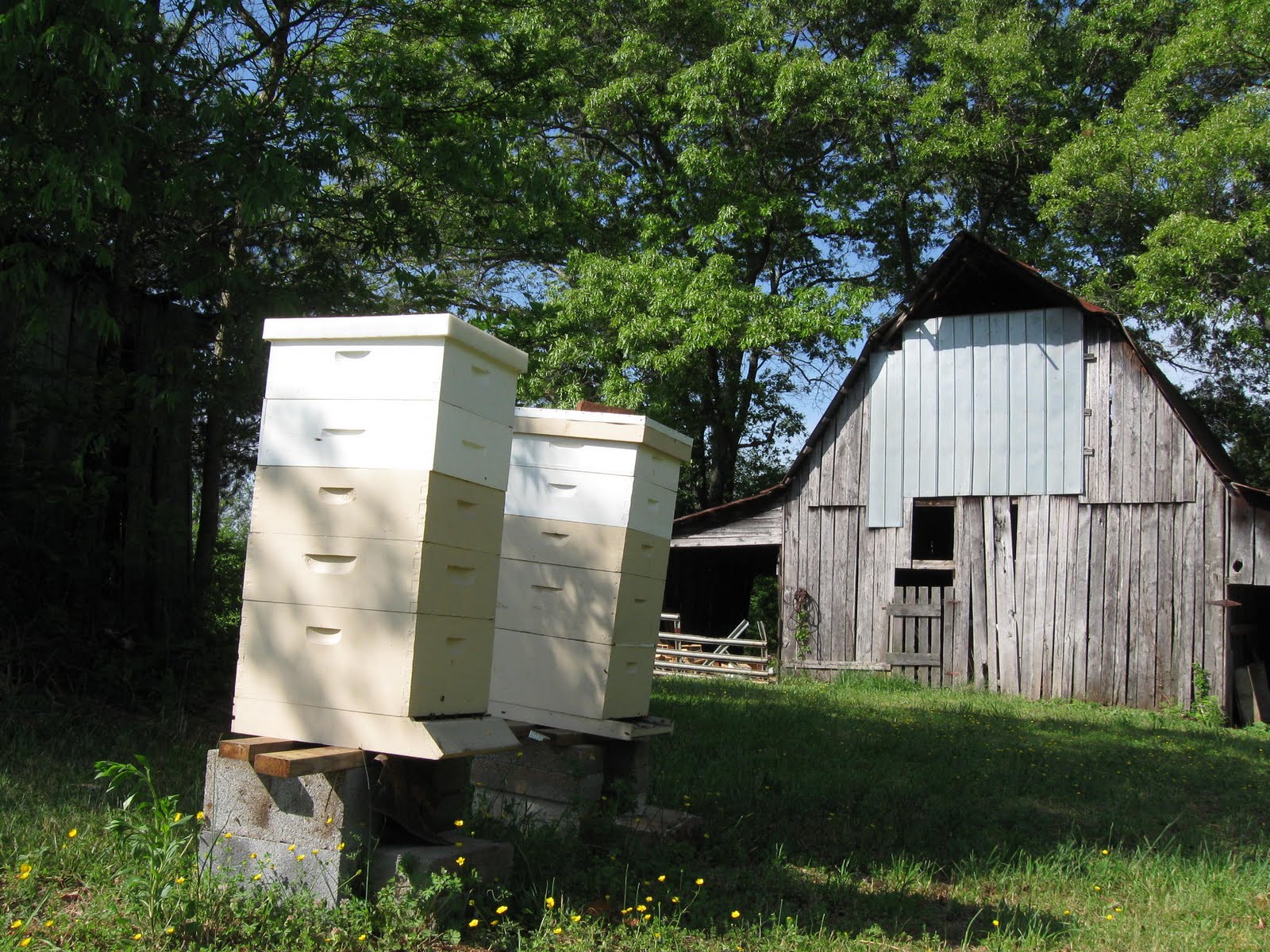
We placed them up in the barnyard, just beyond the toolshed.

We now have a dozen hives on the place. Lots of bees.

Thursday, April 14, 2011

Capturing a swarm

My friend Doug Hardwick made this rather amazing video while capturing a swarm of bees last week. Doug is holding the camera himself, while doing everything else -- climbing the ladder, holding the bucket, shaking the bees, etc.

The amazing part of the video comes in the middle where the bees are on the ground and marching, in military-like formation, into the hive.

Take a look:


Monday, October 19, 2009

Early morning feeding of the bees

With Venus looking down from the east and fog shrouding the trees, I tramped through the dark and the frost this morning to give the bees some food.

It all felt great.

I had done a quick inspection of my three hives late yesterday -- the first for several weeks -- and found all three with plenty of bees. We have had way too much rain this fall, and I hadn't been able to open the hives for a while. I was wondering if the bees had survived.

They had, fortunately.

So now, for the next three or four weeks, let's hope for semi-warm, dry weather. I plan on feeding them at least through the middle of November, maybe even up through Thanksgiving, just to try to keep their numbers up as they head into the winter. Then I will plan to put food in a top feeder with maybe a grease patty or two and close the hives up for the winter.

One worrisome note was that I found small hive beetles in one of the hives. There's not much to be done about them at this point, but that could cause a problem if the hive continues to weaken.

A weather note: Out of 19 days in October, we have had only seven without rain. We have had nearly three inches this month, all of which has not done the bees much good. Any of the fall blooms run the danger of having the nectar washed out of them. If the next few days stay dry, as they are supposed to, we'll see how the bees feed and if they can make any stores for themselves. We have a patch of buckwheat behind the hives that is in full bloom, and I want to see if the bees go for it.

Sunday, June 7, 2009

Inspecting the bees in the middle of the honey season


.


Probably the most fun a beekeeper can have is extracting honey from the hives. But since you do that only once, maybe twice, a year, you have to get your pleasures elsewhere.

You can stand there and watch the hive on a day when the bees are active. That can be fascinating.

But pretty soon, you begin to wonder: "What's going on INSIDE the hive?"

And that's the second "most-fun" part of beekeeping: inspecting the hives.

My friend John and I have six hives on the little farm that Sally and I have in East Tennessee. John is just starting and has two hives. I have four. Since it's the middle of the honey season, John and I both stay eaten up with curiosity about what's going on inside the hives, and yesterday we decided to take a look.

(We try to keep the curiosity in check during this time of year because the bees need to concentrate on making honey rather than dealing with a couple of bumbling humans disrupting their ancient routines. Still, inspecting the hives is a necessary part of beekeeping. You're looking for problems -- overcrowding, critter invasions, etc. -- so that you can help the bees along.)

My first hive is a prize-winner. Rather, the queen is some kind of champ. She has been laying from the moment she was released from the cage back in April, and the hive is full of bees, and those bees are storing up a load of honey. In fact, she is making so many bees that I decided that maybe that hive could share with one of the weaker hives. So, one of my goals yesterday was to find a frame or two of brood cell to put in one of the other hives.

I did just that, and the situation in one of the weaker hives, I found, is more dire than I had suspected. Something must have happened to the queen in the weaker hive because there is some brood cell but not very many bees. I put a frame of brood into that hive, but I'm going to have to watch it closely. I may have to get a new queen before long.

My other two hives are doing well. One has lots of brood, which means the queen has been laying and the population will increase substantially before long. I'm still hopeful of getting some honey from those gals. The other hive is coming along but slowly.

John found both of his hives in good shape with lots of bees and lots of brood. Good queens are doing their work for him. He may not get any honey this year because it's his first year, but he should be in good shape going into the fall.

The wet weather has been both good and bad for the bees this spring. The good part is that it has produced plenty of sources of nectar and pollen for the bees to work. The garden is beginning to come in, and they should enjoy the cucumbers, beans, cantaloupes and sunflowers -- among many other things available to them.

But the bees hate wet weather. The rain cuts down on their ability to forage, and it raises the humidity levels inside the hive. That's right. The bees are far more weather sensitive than we realize. When the inside of the hive gets damp, they have to work to dry it out -- the old fashion way, by flapping their wings.

That's because the honey they're making -- in order to be real honey -- has to be less than 19 percent water. It starts out as more than that, and one of the bees' jobs right now is to get it down to that level so it can be capped. Good dry days in June help that process.

So, now that we've had plenty of rain this spring, pray for dry.

And enjoy the video. (You can also find the video on Vimeo.)

Monday, April 27, 2009

Late-night delivery of nuc hives; the garden is taking shape

• A "bee-running" expedition on Saturday nets us four new hives.

John said it felt like we were running moonshine.

Saturday night, somewhere in the darkness of Blount County, we picked up four nuc hives of bees from Coley Odell, who had put them together for us. The hives were strapped down in the back of the truck and made it to the farm. We pulled them off the truck and set them up on their hive stands, stuck an extra box on top of each, put some feed on the front, and then waited for them to wake up on their new homes on Sunday morning.

It all went well, and now there are six hives in the fold, four for me and two for John.

We took a look inside the hives on Sunday afternoon. Coley had done his work well, and the nuc hives that John had bought and saw plenty of brood cell and no problems.

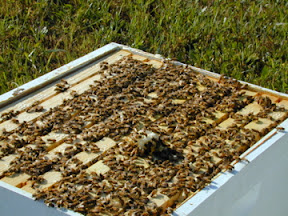
We also looked inside the hives of package bees that I installed three weeks ago, and we found much that was comforting -- lots of brood cell and even some nicely capped honey. (See the picture to the right.) I decided to put a queen excluder on top of the third box and a box of drawn comb on top of that. Now that the feeders are off, that hive is ready to make honey.

The situation was essentially the same with the second hive of packaged bees, although for some reason there seem to be fewer bees at work. Still, there were plenty with brood cell, larva, pollen and honey. I slipped a deep box of mostly drawn comb on top of the bottom box to see if the bees would go down and start working it. I also put a queen excluder on top of the third box and made the top box the hive's first honey super.

Both hives give every indication of being productive with no apparent tendencies to swarm, so I will check them this weekend and see what kind of progress they are making.

Meanwhile, the garden is coming under control.

I spent a good bit of time Sunday taking up the string markers where where the rows of plants have become visible and tilling out the weeds where it was safe to do that. To me, that says the garden is beginning to grow much as I had planned it, and the soil, the plants, the water and God's miracles of biology have to take over. I become more of a secondary player in this drama.

John and I are planning a second raised bed -- this one to be filled with herbs -- and we took advantage of my master carpentry skills (ha!) to put together with some old wood from the smokehouse and the barn. As long as you're not finicky about the way the wood looks, the fact that there might be a few 40-year-old rusty nails here and there in it, and the sizes to which the boards need to be cut, that kind of wood is perfect for our project.

This evening after supper, Sally and I trekked back to the garden where we put some okra and cucumber see in the group, dug the holes for the feet of the new raised bed box and put that into the ground.

So, here's how the garden is shaping up (I have renumbered the row, beginning at the top -- north -- end):

Row 1: yellow corn
Row 2: yellow corn
Row 3: yellow corn
Row 4: beans
Row 5: beans
Row 6: horticulture beans (planted Saturday, April 25)
Row 7: white corn (to be planted next week)
Row 8: white corn (to be planted next week)
Row 9: white corn (to be planted next week)
Row 10: tomatoes
Row 11: beans (striped half runners)
Row 12: okra, cucumbers
Row 13: onions, potatoes (planted March 22)
Row 14: potatoes (Red russets, French fingerlings, Yukon gold from Colorado)
Row 15: potatoes (legacy)
Row 16: peas, potatoes (I may put something else in between these two)

And, finally, as usual: pictures, taken Sunday, April 26.

Sunday, April 19, 2009

The queens are alive

Despite a nagging headcold -- irritating because we are having such beautiful weather in East Tennessee -- I looked inside the two-week-old hives yesterday and found what I wanted to find: brood cell.

That shows there is a working queen inside each hive.

I was having some doubts. You always worry that a hive is not going to accept a queen. Then, I made a mistake in introducing the queen to one of the hives a couple of weeks (pulled out the wrong cork in the queen cage, and she escaped).

And last weekend I looked inside the hives and didn't see any eggs in either hive.

So, what I saw yesterday was a great relief. Both hives are healthy and full of bees. One hive has even capped some honey. I have been feeding both hives heavily, so the honey can't be harvested, but it shows the bees are working.

I will continue to feed these hives for another week or two and then let them have at the ever-increasing set of flowers and blooms that the spring is offering. My friend John and I are due to get to nuc hives from Coley Odell this week, which will bring my total to four fives and put me about where I was last spring. The difference is that this year, I have lots of drawn comb, so the honey production can begin quickly.

Now, if I can just shed this cold . . .

A final note: Worrying about queen acceptance is common among beekeepers. Take a look at this entry from MissBeek, and the excellent photos that go along with it.

Sunday, April 12, 2009

Easter planting - finally


Big time doings in the garden today (Easter).

Finally, after a week of frustration, we had a couple of dry days, which allowed some serious garden work. So here's what happened:

  • The strawberries that John Neal had given me finally got planted in the raised bed box that I made last weekend.

  • Sally planted here lettuce, rhubarb and shallots in the bed at the top of the garden.

  • Sally planted peas in Row 1, which finished most of it out.

  • Jane, Sally and I put yellow corn in Rows 14, 13, and 12. (See picture above.)

  • Sally and I put peanut beans in Rows 10 and 11. Row 9 has been tilled and ready for some horticulture beans.

  • John and I took a thorough look inside the bee hives, and all seems to be well so far. They are busy, making honey and doing what bees should do at this stage.
Friday was rainy, Saturday was cloudy and cool, but today was glorious. Maybe we can get a couple of more days like this in the next week or so to finish the planting.

The pictures below will give you an idea of how the day looked.

Sunday, April 5, 2009

Pouring the bees - 40,000 insects get a new home

Finally, I'm back in the bee business.

I acquired two boxes of bees yesterday, and - along with my friend John - introduced them to their new homes in my apiary. This was an exciting event for all concerned, particularly John, who wants to start beekeeping this year and had never had this experience.

It must have been pretty exciting for the bees, too.

When you acquire bees in this way, they come in boxes somewhat larger than shoebox size made of wood on four sides and screen mesh on two. The screen allows them to have air, of course, but the great thing is that you can look inside and see them hanging together, usually fairly patiently, until they are put into the hive.

In the picture to the right, you can see that a few of the bees had escaped the box, but they didn't leave the colony. Bees are social creatures. They cannot exist alone; they must live in colonies. So, even though these bees found themselves on the outside of the box, they didn't go anywhere.

Seeing the bees like this can be scary for the uninitiated. They look as though they are ready to fly out and attack the nearest creature, but in truth they are docile and most unlikely to sting. They're not protecting anything right now. They are just waiting to see what will hapen with the colony.

My bees came from some place in Georgia and were delivered by long time local beekeeper Howard Kerr. Howard told me he had more orders than he could fill this year because bee die-offs had been somewhat heavy. Since I had lost all of my bees over the winter, I could certain testify to that.

I had prepared two hives for these bees this week. They consisted of three medium boxes, two of which were filled with drawn comb, which will help the bees get started quick on their honey-making procedures. The third box, the top one, is empty for reasons explained below. (See the top picture.)

When John arrived in the early afternoon, we donned our bee suits and veils and got to work.

We opened up the hives, and I took the first box and pried open the top piece of wood, which revealed a can of sugar water (we call it bee juice in our house) hanging within the top of the box. This gives the bees something to eat while they are being transported, and the can in this case was still pretty full.

The next step is to pull the can out of the box and also to pull the queen cage out. The queen comes in her own special cage -- a very small wooden and wire box that protects her from the hive while she is being accepted as the queen. This one insect -- the queen -- is the most important single entity of the hive. She is the one who will keep the hive going because her job is to constantly lay eggs and replenish the hive. Bees instinctively know this, but it still takes a few days for her to establish her position, and she has to be protected in the process.

Once the food and the queen are out of the box, the fun begins -- pouring the bees.

The bees are literally poured, and then shaken, into their new home. You simply turn the box of bees upside down over the empty hive box and let them fall into the hive.

Most of the bees will go in at that point. The sudden move will stir them up to some extent, but they are more surprised than angry and are simply likely to fly up into the air. Eventually they will come down into the hive.

The bees that remain in their original box need to be shaken loose from their moorings -- either other bees or the side of the box -- so they can be dropped into the hive. Stir and shake as you will, you won't get all of them loose, so eventually you have to set the box down next to the hive and trust that sometime during the afternoon they will make their way into the hive.

After that, two more things need to be done. A cork must be extracted from the queen cage that will allow the bees to east on a sugar stopper. Once that sugar stopper is eaten through, the queen will be release, and she can go about her business. Second, the can of food should be place inside the hive, so the bees can continue to eat. In this instance, I place a couple of jars of bee juice on the front of the hive so the bees can have the extra nourishment. In the next few days, the bees will need all of the food they can get.

Once these tasks are done, the top cover goes back onto the hive, and that's it. The front of the hive is open, so the bees that are outside the hive at this moment will find their way inside. It may take a couple of hours, but by dark it will happen because the social instincts will kick in. Bees always want to be with the colony.

Our operations did not go perfectly smoothly yesterday because of a rookie mistake I made. I pulled out the wrong cork from one of the queen cages, which released her immediately into the hive. I did that same thing the first time I poured bees a couple of years ago. It turned out to be okay then because the queen had spent enough time with the other bees already that they accepted her without a problem. I am hopeful that will happen again.

If not, we'll have another problem -- but not an insolvable one -- to deal with.

. . .

Installing the bees was just one thing that happened in the garden yesterday. It was a beautiful day, and even though it was still to wet to plow, I was able to till a bit and do some other things. Here's how it looked:


Sunday, March 8, 2009

First light at the end of winter's long tunnel


The first light at the end of winter's long, cold and wet tunnel appeared this weekend. With temperatures in the 60s and no rain, it was the first time this year I've had the chance to do any real work in the garden and elsewhere.


So, I took advantage.

The first thing I did Saturday morning was sort the potatoes. I had about 15 pounds of potatoes left over from last year's harvest. They had been stored in the basement, and nearly every one of them, even the very smallest, had developed sprouts. I checked with the good folks at Ronniger's in Colorado, where I had ordered them last year, to see if there was any reason not to put those in the ground this spring.

There isn't. So, Saturday morning I sorted.

I ended up with what will be enough seed potatoes for a row of banana ("the superstar of fingerling potatoes," according to Ronniger's) potatoes. I'll also have enough Russets and various others -- French fingerlings, Yukon gold -- for another row. This morning I ordered enough from Ronniger's to fill a third row with Russets, French fingerlings and Yukon Gold.

The Russets and French fingerlings did very well last year, so I thought I would go with what has worked before. The Yukon golds were bought locally and didn't produce so well, so I thought I would give them another shot with the Colorado imports.

Growing potatoes was one of the great gardening thrills I had last year, and I hope I can duplicate it this year.

The garden

I had mentioned here before that Kenneth, the fellow who plowed my garden last fall, got enthusiastic and just about doubled the size of the plot. I got a taste of just how big he had made the garden on Saturday when I pulled out the tiller and started breaking up the ground.

The garden is now 125 feet long and about 75 feet wide. That's a very long row. I tilled for about an hour and got about a third of the plot turned over. Much more tilling in my near future.

The bees

I have been reluctant to post much about the bees lately because disaster struck about three weeks ago. We had a brief warm spell, and I had decided to put some Apistan strips in the two hive that I had left, but when I opened them up, there was nothing left but a few dead bees. Both hives had died out completely.

My guess, confirmed by my friend Jim, was that the winter was simply too long and cold and they starved to death.

This was a huge disappointment because I believe both hives to be healthy and active, and I had been looking forward to just this time so I could shift the boxes around and get them ready for the spring. Instead, I have had to call Howard and reserve some boxes of bees that he will be bringing on April 4.

The one slightly silver lining in all this is that I have plenty of drawn comb -- pure gold for the beekeeper -- so when the new bees show up, they shouldn't have any trouble getting started. I still look forward to a honey harvest in July.

The coming of spring

The first paragraph of this post described winter as long, cold and wet. The good thing about that was the "wet" part. East Tennessee made a valiant attempt to climb out of its drought this winter with goodly amounts of rain in November, December and January. The ground is moist, and nature seems anxious to take off in these last three weeks before spring officially descends.

Saturday, September 13, 2008

The most aggrevatin'-ist thing - part 2

The re-queening is finished. Long live the new queens!

It was the most frustrating part of beekeeping that I have encountered since I started, and I cannot claim total success, but at least it's done.

ALERT: Technical beekeeping info (skip this if you're not interested)

The method of finding the old queen that Coley O'Dell described (and I referred to in the previous post) went something like this: Set up a hive box with a queen excluder covering the bottom. Shake (or brush) the bees off the frame and into the box. Apply smoke. The worker bees will fly out of the box while the queen, heavy with eggs, is likely to stay there. Then she will be easier to spot.

I did that, and it worked with one box and didn't with another. It didn't work, I think, because I am not adept at spotting a queen yet. She could have been in there, and I just didn't see her. With the other box, I had to cover the top with a queen excluder and let the bees filter themselves out over night. They did, and the next day I spotted the queen and killed her.

End ALERT.

So, I have new queens in all of the hives, and they still have a good bit of the fall foraging season left. One of the hives (Hive 3) is so strong that it has already begun to cap some honey. With any luck, all of the hives will be in good shape to go into the winter,

Saturday, September 6, 2008

The most aggrevatin'-ist thing

• Re-queening a beehive is the hardest, most tedious task in beekeeping.

"It's the hardest, most aggrevatin'-ist thing you can do when you keep bees."

My anonymous friend was talking about re-queening a hive.

I second that emotion.

I ordered new queens for all five hives this year, being told that good bee management says you should re-queen your hives at least once every two years. Some people re-queen every year, which is even better bee management. A hive with a young queen will produce more bees and is likely to stay healthier and ultimately produce more honey.

The problem is getting the queen into the hive. Actually, the real problem is finding the old queen and killing her so the new queen will be accepted. A queen is somewhat longer than worker bees and thinner than a drone. She has pretty much the same markings as the worker bees, although her wing shape is a little different.

Since there is only one queen per hive, you have to find this one slightly different critter among as many as 30,000 or 40,000 other critters. It's a real life needle-in-a-haystack problem.

So, here's the score. My friend Jim Brown has been helping me, mainly because I'm not experienced enough to recognize a queen by my self. On our first go at it, we determined that two of the hives (Hives 4 and 5) had lost their queens -- which made it pretty easy to get the new queens in. Jim found the queen in a third hive (Hive 2). We could not find the queen in Hives 1 and 3. Jim has been back once to look, and I have been in the hives three times for a total of around five hours looking for the queens.

No luck.

So far, new queens 3 - old queens 2.

I saw Coley O'Dell at the farmer's market this morning, and as usual, Coley had good advice. He described the method that he uses to find a queen that otherwise won't be found. I am going to give it a try this evening or something tomorrow. Stay tuned.

Sunday, June 1, 2008

Buzzing the Web: BeeMaster.com forum

  • The BeeMaster.com forum is one of the top places on the web to meet fellow beekeepers from all over the world.
Let’s say it’s another two weeks until the next beekeepers association meeting, and you’re feeling the need to talk bees. Your family of non-beekeepers isn’t interested. Your best bee buddy is out of town. The crowd at Cracker Barrel looks like a bunch of syrup-soppers rather than honey-loves.

What to do?

There’s a site on the web that’s perfect. It’s the forum on the BeeMaster.com site. The BeeMaster forum bills itself as the number one beekeepers forum in the world, and they’re probably right on that. Post a question, pose a problem, or just tell your latest bee story, and you will get an almost instant response. And the response will come from all over the world.

The forum is well-organized, so it is easy to find your way around. In fact, there are a number of sub-forums that are devoted to specific topics like the growth of the beeyard, pests and treatments, raising new queens and the like. One of these forums, called the Trading Post, is just what it says – a place where you can buy and sell equipment. There’s a forum for people who have their own web sites and blogs, and there’s even a forum called The Coffee House, where you talk about non bee-related things to others interested in beekeeping.

And, since many of us are also gardeners as well as beekeepers, there’s a gardener’s forum.

One of the nice things about all of this is that the forum is tightly monitored and moderated, which makes sure that one gets uncivil or abuses their privileges.

You have to register to participate in the forum, and you have to post several entries before you get full privileges to post links or upload pictures. That’s a bit irritating, but you can go online to ask questions and make comments immediately, and that’s a good thing.

I have posted several things on the BeeMaster forum, and I have always gotten friendly, well-meaning responses from people who are genuinely interested in what you have to say. It’s kind of like the Blount County Beekeepers Association meeting all day and night and all over the world.

This is a wonderful site, and if you want to extend your circle of bee buddies, I highly recommend it.