Despite a nagging headcold -- irritating because we are having such beautiful weather in East Tennessee -- I looked inside the two-week-old hives yesterday and found what I wanted to find: brood cell.
That shows there is a working queen inside each hive.
I was having some doubts. You always worry that a hive is not going to accept a queen. Then, I made a mistake in introducing the queen to one of the hives a couple of weeks (pulled out the wrong cork in the queen cage, and she escaped).
And last weekend I looked inside the hives and didn't see any eggs in either hive.
So, what I saw yesterday was a great relief. Both hives are healthy and full of bees. One hive has even capped some honey. I have been feeding both hives heavily, so the honey can't be harvested, but it shows the bees are working.
I will continue to feed these hives for another week or two and then let them have at the ever-increasing set of flowers and blooms that the spring is offering. My friend John and I are due to get to nuc hives from Coley Odell this week, which will bring my total to four fives and put me about where I was last spring. The difference is that this year, I have lots of drawn comb, so the honey production can begin quickly.
Now, if I can just shed this cold . . .
A final note: Worrying about queen acceptance is common among beekeepers. Take a look at this entry from MissBeek, and the excellent photos that go along with it.
Sunday, April 19, 2009
The queens are alive

Sunday, April 5, 2009
Pouring the bees - 40,000 insects get a new home
 Finally, I'm back in the bee business.
I acquired two boxes of bees yesterday, and - along with my friend John - introduced them to their new homes in my apiary. This was an exciting event for all concerned, particularly John, who wants to start beekeeping this year and had never had this experience.
It must have been pretty exciting for the bees, too.
When you acquire bees in this way, they come in boxes somewhat larger than shoebox size made of wood on four sides and screen mesh on two. The screen allows them to have air, of course, but the great thing is that you can look inside and see them hanging together, usually fairly patiently, until they are put into the hive.
In the picture to the right, you can see that a few of the bees had escaped the box, but they didn't leave the colony. Bees are social creatures. They cannot exist alone; they must live in colonies. So, even though these bees found themselves on the outside of the box, they didn't go anywhere.
Seeing the bees like this can be scary for the uninitiated. They look as though they are ready to fly out and attack the nearest creature, but in truth they are docile and most unlikely to sting. They're not protecting anything right now. They are just waiting to see what will hapen with the colony.
My bees came from some place in Georgia and were delivered by long time local beekeeper Howard Kerr. Howard told me he had more orders than he could fill this year because bee die-offs had been somewhat heavy. Since I had lost all of my bees over the winter, I could certain testify to that.
I had prepared two hives for these bees this week. They consisted of three medium boxes, two of which were filled with drawn comb, which will help the bees get started quick on their honey-making procedures. The third box, the top one, is empty for reasons explained below. (See the top picture.)
When John arrived in the early afternoon, we donned our bee suits and veils and got to work.
We opened up the hives, and I took the first box and pried open the top piece of wood, which revealed a can of sugar water (we call it bee juice in our house) hanging within the top of the box. This gives the bees something to eat while they are being transported, and the can in this case was still pretty full.
The next step is to pull the can out of the box and also to pull the queen cage out. The queen comes in her own special cage -- a very small wooden and wire box that protects her from the hive while she is being accepted as the queen. This one insect -- the queen -- is the most important single entity of the hive. She is the one who will keep the hive going because her job is to constantly lay eggs and replenish the hive. Bees instinctively know this, but it still takes a few days for her to establish her position, and she has to be protected in the process.
Once the food and the queen are out of the box, the fun begins -- pouring the bees.
The bees are literally poured, and then shaken, into their new home. You simply turn the box of bees upside down over the empty hive box and let them fall into the hive.
Most of the bees will go in at that point. The sudden move will stir them up to some extent, but they are more surprised than angry and are simply likely to fly up into the air. Eventually they will come down into the hive.
The bees that remain in their original box need to be shaken loose from their moorings -- either other bees or the side of the box -- so they can be dropped into the hive. Stir and shake as you will, you won't get all of them loose, so eventually you have to set the box down next to the hive and trust that sometime during the afternoon they will make their way into the hive.
After that, two more things need to be done. A cork must be extracted from the queen cage that will allow the bees to east on a sugar stopper. Once that sugar stopper is eaten through, the queen will be release, and she can go about her business. Second, the can of food should be place inside the hive, so the bees can continue to eat. In this instance, I place a couple of jars of bee juice on the front of the hive so the bees can have the extra nourishment. In the next few days, the bees will need all of the food they can get.
Once these tasks are done, the top cover goes back onto the hive, and that's it. The front of the hive is open, so the bees that are outside the hive at this moment will find their way inside. It may take a couple of hours, but by dark it will happen because the social instincts will kick in. Bees always want to be with the colony.
Our operations did not go perfectly smoothly yesterday because of a rookie mistake I made. I pulled out the wrong cork from one of the queen cages, which released her immediately into the hive. I did that same thing the first time I poured bees a couple of years ago. It turned out to be okay then because the queen had spent enough time with the other bees already that they accepted her without a problem. I am hopeful that will happen again.
If not, we'll have another problem -- but not an insolvable one -- to deal with.
. . .
Installing the bees was just one thing that happened in the garden yesterday. It was a beautiful day, and even though it was still to wet to plow, I was able to till a bit and do some other things. Here's how it looked:
Saturday, September 13, 2008
The most aggrevatin'-ist thing - part 2
The re-queening is finished. Long live the new queens!
It was the most frustrating part of beekeeping that I have encountered since I started, and I cannot claim total success, but at least it's done.
ALERT: Technical beekeeping info (skip this if you're not interested)
The method of finding the old queen that Coley O'Dell described (and I referred to in the previous post) went something like this: Set up a hive box with a queen excluder covering the bottom. Shake (or brush) the bees off the frame and into the box. Apply smoke. The worker bees will fly out of the box while the queen, heavy with eggs, is likely to stay there. Then she will be easier to spot.
I did that, and it worked with one box and didn't with another. It didn't work, I think, because I am not adept at spotting a queen yet. She could have been in there, and I just didn't see her. With the other box, I had to cover the top with a queen excluder and let the bees filter themselves out over night. They did, and the next day I spotted the queen and killed her.
End ALERT.
So, I have new queens in all of the hives, and they still have a good bit of the fall foraging season left. One of the hives (Hive 3) is so strong that it has already begun to cap some honey. With any luck, all of the hives will be in good shape to go into the winter,
Saturday, September 6, 2008
The most aggrevatin'-ist thing
• Re-queening a beehive is the hardest, most tedious task in beekeeping.
"It's the hardest, most aggrevatin'-ist thing you can do when you keep bees."
My anonymous friend was talking about re-queening a hive.
I second that emotion.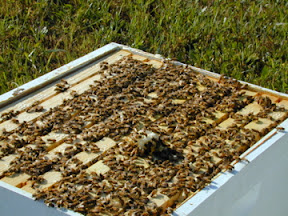
I ordered new queens for all five hives this year, being told that good bee management says you should re-queen your hives at least once every two years. Some people re-queen every year, which is even better bee management. A hive with a young queen will produce more bees and is likely to stay healthier and ultimately produce more honey.
The problem is getting the queen into the hive. Actually, the real problem is finding the old queen and killing her so the new queen will be accepted. A queen is somewhat longer than worker bees and thinner than a drone. She has pretty much the same markings as the worker bees, although her wing shape is a little different.
Since there is only one queen per hive, you have to find this one slightly different critter among as many as 30,000 or 40,000 other critters. It's a real life needle-in-a-haystack problem.
So, here's the score. My friend Jim Brown has been helping me, mainly because I'm not experienced enough to recognize a queen by my self. On our first go at it, we determined that two of the hives (Hives 4 and 5) had lost their queens -- which made it pretty easy to get the new queens in. Jim found the queen in a third hive (Hive 2). We could not find the queen in Hives 1 and 3. Jim has been back once to look, and I have been in the hives three times for a total of around five hours looking for the queens.
No luck.
So far, new queens 3 - old queens 2.
I saw Coley O'Dell at the farmer's market this morning, and as usual, Coley had good advice. He described the method that he uses to find a queen that otherwise won't be found. I am going to give it a try this evening or something tomorrow. Stay tuned.