The re-queening is finished. Long live the new queens!
It was the most frustrating part of beekeeping that I have encountered since I started, and I cannot claim total success, but at least it's done.
ALERT: Technical beekeeping info (skip this if you're not interested)
The method of finding the old queen that Coley O'Dell described (and I referred to in the previous post) went something like this: Set up a hive box with a queen excluder covering the bottom. Shake (or brush) the bees off the frame and into the box. Apply smoke. The worker bees will fly out of the box while the queen, heavy with eggs, is likely to stay there. Then she will be easier to spot.
I did that, and it worked with one box and didn't with another. It didn't work, I think, because I am not adept at spotting a queen yet. She could have been in there, and I just didn't see her. With the other box, I had to cover the top with a queen excluder and let the bees filter themselves out over night. They did, and the next day I spotted the queen and killed her.
End ALERT.
So, I have new queens in all of the hives, and they still have a good bit of the fall foraging season left. One of the hives (Hive 3) is so strong that it has already begun to cap some honey. With any luck, all of the hives will be in good shape to go into the winter,
Saturday, September 13, 2008
The most aggrevatin'-ist thing - part 2

Saturday, September 6, 2008
The most aggrevatin'-ist thing
• Re-queening a beehive is the hardest, most tedious task in beekeeping.
"It's the hardest, most aggrevatin'-ist thing you can do when you keep bees."
My anonymous friend was talking about re-queening a hive.
I second that emotion.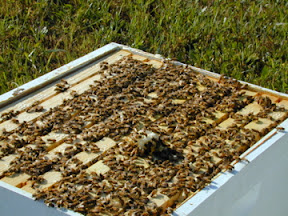
I ordered new queens for all five hives this year, being told that good bee management says you should re-queen your hives at least once every two years. Some people re-queen every year, which is even better bee management. A hive with a young queen will produce more bees and is likely to stay healthier and ultimately produce more honey.
The problem is getting the queen into the hive. Actually, the real problem is finding the old queen and killing her so the new queen will be accepted. A queen is somewhat longer than worker bees and thinner than a drone. She has pretty much the same markings as the worker bees, although her wing shape is a little different.
Since there is only one queen per hive, you have to find this one slightly different critter among as many as 30,000 or 40,000 other critters. It's a real life needle-in-a-haystack problem.
So, here's the score. My friend Jim Brown has been helping me, mainly because I'm not experienced enough to recognize a queen by my self. On our first go at it, we determined that two of the hives (Hives 4 and 5) had lost their queens -- which made it pretty easy to get the new queens in. Jim found the queen in a third hive (Hive 2). We could not find the queen in Hives 1 and 3. Jim has been back once to look, and I have been in the hives three times for a total of around five hours looking for the queens.
No luck.
So far, new queens 3 - old queens 2.
I saw Coley O'Dell at the farmer's market this morning, and as usual, Coley had good advice. He described the method that he uses to find a queen that otherwise won't be found. I am going to give it a try this evening or something tomorrow. Stay tuned.