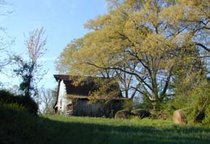
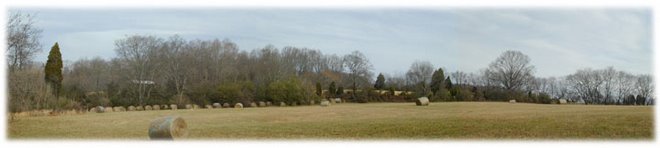
Here's a slideshow (with music from brother-in-law Frank) of what the day was like on the farm:
Showing posts with label gardening. Show all posts
Showing posts with label gardening. Show all posts
Monday, April 9, 2012
Easter around the farm

Wednesday, April 13, 2011
Progress in the garden, then rain
Progress in the garden. Then rain. A good combination.
The weekend turned pretty beautiful on us, so we were able to set some things out this weekend: corn, peanuts, beans and peas. Plus a couple of early-bearing tomatoes (so they say).
Then it started raining Monday night and didn't stop until Tuesday afternoon.
This morning we awoke to all kinds of new shades of green.
So, here's the garden so far.
Row 6 (east to west): Yukon Gold; mixture
Row 7: Red Gold; Russian banana (fingerlings)
Row 8: Russian bananas
Row 9: French fingerlings
Row 10: Peanut fingerlings
Row 11: Onions
Row 12:
Row 13:
Row 14:
Row 15:
Row 16:
Row 17:
Row 18: Beans | Peas
Row 19: Beans | Peas
Row 20: Yellow corn
Row 21: Yellow corn
Row 22: Yellow corn
Row 23: Yellow corn
Row 24: (a new row, made with plenty of tilling on Sunday) Peanuts
We planted the two tomatoes off the rows at the west end of the garden, just to give them more space. We'll see how they do.
Tuesday, May 11, 2010
Jim Brown talks about plants that are good for bees
Herbalist and Blount County Beekeepers Association member Jim Brown talked about a variety of plants that are good for bees at the last meeting of the BCBA on May 9, 2010.
Brown had an extensive list of plants, and I have included short audio clips of five of the plants that he discussed:
Bee balm
"It's a bit of a spreader, and sometimes the leaves will turn a bit of a gray on you. . . . It makes a lot of nice, pretty flowers. It's a mid-summer bloomer."
(1 minute 22 seconds)
Catnip
Bees love it as well as cats, and it repels mosquitos.
(1:25)
Rosemary
Rosemary is one of the more common plants that people grow. Bees like the pretty blue flowers, but it blooms at a variety of times -- sometimes early, sometime late. Rosemary, the legend says, is only suppose to grow in the garden of a righteous person. Rosemary does not grown well inside, so don't bring them in your house.
(2:52)
Thyme
"I've seen a hundred honeybees on a thyme plant over at UT gardens." There are lots of varieties, and thyme is a herb that goes well in just about any recipe. The blooms are tiny, but the bees love them.
(1:30)
Vitex-Chasetree
Vitex is a great bee plant. It blooms late in the summer and into the fall, and the bees are all over it. It has a beautiful blue bloom that looks a little like a lilac. Vitex grows very fast. It is actually a tree, but gardeners can do a lot with it according to how they want it to look in their garden.
(3:12)
Jim and his wife Delores operate the Honey Rock Herb Farm in Louisville.
Sunday, June 7, 2009
Inspecting the bees in the middle of the honey season
.
Probably the most fun a beekeeper can have is extracting honey from the hives. But since you do that only once, maybe twice, a year, you have to get your pleasures elsewhere.
You can stand there and watch the hive on a day when the bees are active. That can be fascinating.
But pretty soon, you begin to wonder: "What's going on INSIDE the hive?"
And that's the second "most-fun" part of beekeeping: inspecting the hives.
My friend John and I have six hives on the little farm that Sally and I have in East Tennessee. John is just starting and has two hives. I have four. Since it's the middle of the honey season, John and I both stay eaten up with curiosity about what's going on inside the hives, and yesterday we decided to take a look.
(We try to keep the curiosity in check during this time of year because the bees need to concentrate on making honey rather than dealing with a couple of bumbling humans disrupting their ancient routines. Still, inspecting the hives is a necessary part of beekeeping. You're looking for problems -- overcrowding, critter invasions, etc. -- so that you can help the bees along.)
My first hive is a prize-winner. Rather, the queen is some kind of champ. She has been laying from the moment she was released from the cage back in April, and the hive is full of bees, and those bees are storing up a load of honey. In fact, she is making so many bees that I decided that maybe that hive could share with one of the weaker hives. So, one of my goals yesterday was to find a frame or two of brood cell to put in one of the other hives.
I did just that, and the situation in one of the weaker hives, I found, is more dire than I had suspected. Something must have happened to the queen in the weaker hive because there is some brood cell but not very many bees. I put a frame of brood into that hive, but I'm going to have to watch it closely. I may have to get a new queen before long.
My other two hives are doing well. One has lots of brood, which means the queen has been laying and the population will increase substantially before long. I'm still hopeful of getting some honey from those gals. The other hive is coming along but slowly.

John found both of his hives in good shape with lots of bees and lots of brood. Good queens are doing their work for him. He may not get any honey this year because it's his first year, but he should be in good shape going into the fall.
The wet weather has been both good and bad for the bees this spring. The good part is that it has produced plenty of sources of nectar and pollen for the bees to work. The garden is beginning to come in, and they should enjoy the cucumbers, beans, cantaloupes and sunflowers -- among many other things available to them.
But the bees hate wet weather. The rain cuts down on their ability to forage, and it raises the humidity levels inside the hive. That's right. The bees are far more weather sensitive than we realize. When the inside of the hive gets damp, they have to work to dry it out -- the old fashion way, by flapping their wings.
That's because the honey they're making -- in order to be real honey -- has to be less than 19 percent water. It starts out as more than that, and one of the bees' jobs right now is to get it down to that level so it can be capped. Good dry days in June help that process.
So, now that we've had plenty of rain this spring, pray for dry.
And enjoy the video. (You can also find the video on Vimeo.)
Sunday, April 12, 2009
Easter planting - finally

Big time doings in the garden today (Easter).
Finally, after a week of frustration, we had a couple of dry days, which allowed some serious garden work. So here's what happened:
- The strawberries that John Neal had given me finally got planted in the raised bed box that I made last weekend.
- Sally planted here lettuce, rhubarb and shallots in the bed at the top of the garden.
- Sally planted peas in Row 1, which finished most of it out.
- Jane, Sally and I put yellow corn in Rows 14, 13, and 12. (See picture above.)
- Sally and I put peanut beans in Rows 10 and 11. Row 9 has been tilled and ready for some horticulture beans.
- John and I took a thorough look inside the bee hives, and all seems to be well so far. They are busy, making honey and doing what bees should do at this stage.
The pictures below will give you an idea of how the day looked.
Wednesday, April 8, 2009
A dry garden and more potatoes
The garden dried out enough over the weekend so that we able to put in some potatoes on Sunday (April 5). So, for the record, here's what we planted:
Row 3: French fingerings, Red Russets, Yukon Gold
Row 2: legacy potatoes (these are a mix of those left from last year)
Row 1: [unplanted], legacy, Red Pontiacs
The west part of row 1 still has some room, and if I can find some potatoes I like, I'll put some more in to fill out the row.
Here's what the Washington State University comprehensive description of potato varieties says about Red Pontiacs:
Tubers are "oblong to round; smooth, sometimes netted, red skin; medium deep eyes; white flesh.... High yielding variety of attractive appearance, widely adapted (especially to muck soils). Some drought resistance, bruises easily; susceptible to air cracking at harvest. Low total solids. Good storability, medium dormancy."And more about this variety can be found at the Red Pontiac page of the Canadian Food Inspection Agency.
I am interested to see how the potatoes from last year (which I have named "legacy" potatoes) do. They are relatively small and shriveled, but they came from stock that produced well last year, so I have some hope for them. Most of them look like Russian bananas, but we'll see.
Because of the bad weather, we have been late getting these things into the ground, so it will be well into July before we can see how well they are doing. We harvested the potatoes last year a little too early (July 4), and I am determined to wait until at least the end of July before digging them up. Which is not to say I won't be sneaking a few new potatoes out of the garden toward the end of June.
In any event, it's good to have things in the ground.
Cold weather for the past couple of nights gave us a scare, more for the new bees than anything else. But it never got much below freezing, and it looks like today will be sunny with temps climbing to the 60s.
Are we done with winter yet?
Sunday, April 5, 2009
Pouring the bees - 40,000 insects get a new home
 Finally, I'm back in the bee business.
I acquired two boxes of bees yesterday, and - along with my friend John - introduced them to their new homes in my apiary. This was an exciting event for all concerned, particularly John, who wants to start beekeeping this year and had never had this experience.
It must have been pretty exciting for the bees, too.
When you acquire bees in this way, they come in boxes somewhat larger than shoebox size made of wood on four sides and screen mesh on two. The screen allows them to have air, of course, but the great thing is that you can look inside and see them hanging together, usually fairly patiently, until they are put into the hive.
In the picture to the right, you can see that a few of the bees had escaped the box, but they didn't leave the colony. Bees are social creatures. They cannot exist alone; they must live in colonies. So, even though these bees found themselves on the outside of the box, they didn't go anywhere.
Seeing the bees like this can be scary for the uninitiated. They look as though they are ready to fly out and attack the nearest creature, but in truth they are docile and most unlikely to sting. They're not protecting anything right now. They are just waiting to see what will hapen with the colony.
My bees came from some place in Georgia and were delivered by long time local beekeeper Howard Kerr. Howard told me he had more orders than he could fill this year because bee die-offs had been somewhat heavy. Since I had lost all of my bees over the winter, I could certain testify to that.
I had prepared two hives for these bees this week. They consisted of three medium boxes, two of which were filled with drawn comb, which will help the bees get started quick on their honey-making procedures. The third box, the top one, is empty for reasons explained below. (See the top picture.)
When John arrived in the early afternoon, we donned our bee suits and veils and got to work.
We opened up the hives, and I took the first box and pried open the top piece of wood, which revealed a can of sugar water (we call it bee juice in our house) hanging within the top of the box. This gives the bees something to eat while they are being transported, and the can in this case was still pretty full.
The next step is to pull the can out of the box and also to pull the queen cage out. The queen comes in her own special cage -- a very small wooden and wire box that protects her from the hive while she is being accepted as the queen. This one insect -- the queen -- is the most important single entity of the hive. She is the one who will keep the hive going because her job is to constantly lay eggs and replenish the hive. Bees instinctively know this, but it still takes a few days for her to establish her position, and she has to be protected in the process.
Once the food and the queen are out of the box, the fun begins -- pouring the bees.
The bees are literally poured, and then shaken, into their new home. You simply turn the box of bees upside down over the empty hive box and let them fall into the hive.
Most of the bees will go in at that point. The sudden move will stir them up to some extent, but they are more surprised than angry and are simply likely to fly up into the air. Eventually they will come down into the hive.
The bees that remain in their original box need to be shaken loose from their moorings -- either other bees or the side of the box -- so they can be dropped into the hive. Stir and shake as you will, you won't get all of them loose, so eventually you have to set the box down next to the hive and trust that sometime during the afternoon they will make their way into the hive.
After that, two more things need to be done. A cork must be extracted from the queen cage that will allow the bees to east on a sugar stopper. Once that sugar stopper is eaten through, the queen will be release, and she can go about her business. Second, the can of food should be place inside the hive, so the bees can continue to eat. In this instance, I place a couple of jars of bee juice on the front of the hive so the bees can have the extra nourishment. In the next few days, the bees will need all of the food they can get.
Once these tasks are done, the top cover goes back onto the hive, and that's it. The front of the hive is open, so the bees that are outside the hive at this moment will find their way inside. It may take a couple of hours, but by dark it will happen because the social instincts will kick in. Bees always want to be with the colony.
Our operations did not go perfectly smoothly yesterday because of a rookie mistake I made. I pulled out the wrong cork from one of the queen cages, which released her immediately into the hive. I did that same thing the first time I poured bees a couple of years ago. It turned out to be okay then because the queen had spent enough time with the other bees already that they accepted her without a problem. I am hopeful that will happen again.
If not, we'll have another problem -- but not an insolvable one -- to deal with.
. . .
Installing the bees was just one thing that happened in the garden yesterday. It was a beautiful day, and even though it was still to wet to plow, I was able to till a bit and do some other things. Here's how it looked:
Sunday, March 8, 2009
First light at the end of winter's long tunnel
The first light at the end of winter's long, cold and wet tunnel appeared this weekend. With temperatures in the 60s and no rain, it was the first time this year I've had the chance to do any real work in the garden and elsewhere.
So, I took advantage.
The first thing I did Saturday morning was sort the potatoes. I had about 15 pounds of potatoes left over from last year's harvest. They had been stored in the basement, and nearly every one of them, even the very smallest, had developed sprouts. I checked with the good folks at Ronniger's in Colorado, where I had ordered them last year, to see if there was any reason not to put those in the ground this spring.
There isn't. So, Saturday morning I sorted.
I ended up with what will be enough seed potatoes for a row of banana ("the superstar of fingerling potatoes," according to Ronniger's) potatoes. I'll also have enough Russets and various others -- French fingerlings, Yukon gold -- for another row. This morning I ordered enough from Ronniger's to fill a third row with Russets, French fingerlings and Yukon Gold.
The Russets and French fingerlings did very well last year, so I thought I would go with what has worked before. The Yukon golds were bought locally and didn't produce so well, so I thought I would give them another shot with the Colorado imports.
Growing potatoes was one of the great gardening thrills I had last year, and I hope I can duplicate it this year.
The garden
I had mentioned here before that Kenneth, the fellow who plowed my garden last fall, got enthusiastic and just about doubled the size of the plot. I got a taste of just how big he had made the garden on Saturday when I pulled out the tiller and started breaking up the ground.
The garden is now 125 feet long and about 75 feet wide. That's a very long row. I tilled for about an hour and got about a third of the plot turned over. Much more tilling in my near future.
The bees
I have been reluctant to post much about the bees lately because disaster struck about three weeks ago. We had a brief warm spell, and I had decided to put some Apistan strips in the two hive that I had left, but when I opened them up, there was nothing left but a few dead bees. Both hives had died out completely.
My guess, confirmed by my friend Jim, was that the winter was simply too long and cold and they starved to death.
This was a huge disappointment because I believe both hives to be healthy and active, and I had been looking forward to just this time so I could shift the boxes around and get them ready for the spring. Instead, I have had to call Howard and reserve some boxes of bees that he will be bringing on April 4.
The one slightly silver lining in all this is that I have plenty of drawn comb -- pure gold for the beekeeper -- so when the new bees show up, they shouldn't have any trouble getting started. I still look forward to a honey harvest in July.
The coming of spring
The first paragraph of this post described winter as long, cold and wet. The good thing about that was the "wet" part. East Tennessee made a valiant attempt to climb out of its drought this winter with goodly amounts of rain in November, December and January. The ground is moist, and nature seems anxious to take off in these last three weeks before spring officially descends.
Saturday, December 6, 2008
December ponderings, mixed with a bit of snow
A large plowed field will be waiting for me in the spring
A couple of weeks ago, a neighbor drove his tractor and plow up the road to my garden and gave it a once-over. We had been generous with the honey we had given to him and his wife, so he returned the favor, and we are grateful to him.
I had in mind extending the garden from last year's dimensions, and I had marked off -- more or less -- the borders that I wanted him to plow.
Kenneth (the neighbor) apparently didn't think I was working hard enough, however, so he proceeded to plow beyond my markings, and now I have a garden that's about 150 feet long and 50 feet. I suspect that gives me nearly twice the growing space that I had last spring and summer.
Whew!
That will certainly make for an interesting planting and growing season next year. Right now, and for the next three months, its planning season. And right on schedule, the seed catalogues have begun to show up. Today, we got one from Totally Tomato.
Looking at the pictures, I begin to imagine what next year might be like.
I do that after walking around the garden this morning as the snow was coming down and even beginning to stick. The snow won't amount to much today, but it was pretty and pleasant and non-threatening.
It reminds me of how different things will look six months from now.
And that difference is one of God's blessings to us.
Sunday, July 6, 2008
Potatoes on the Fourth
We harvested our first crop of potatoes on July 4. It seemed like an appropriately American thing to do, and it turned out to be more exciting than a fireworks show.
I have loved potatoes since I was a small child and have secretly harbored a desire to grow them for a long time. That desire was renewed a couple of years ago when we lived in Virginia and visited the Abingdon farmers market regularly. Later in the season, a fellow would show up with a potato I had never seen before -- a small, longish white potato called a French fingerling. We roasted them as he suggested and got hooked.
The guy who sold us the potatoes told me he had ordered the seed potatoes from Colorado, but they obviously took to the local climate, and I told myself then, "If you ever get the chance, those are the kind you are going to grow."
Of course, there are many kinds of potatoes, and to limit yourself to one kind is as unwise as limiting yourself to one kind of ice cream. So, early this year when I started planning the garden, I found Ronniger's in Colorado as a source for seed potatoes. I started through their web site and got dazzled by the many kinds and varieties they had available. They did have French fingerlings, and that was where I started.
Now, I should state at this point that I knew nothing -- NOTHING -- about preparing, planting or digging potatoes. My ignorance was absolute. (Had someone told me that potatoes grew on potato trees, I probably would have believed them.) But I was determined. I read what I could find about the process. I tried to ask questions in a way that wouldn't reveal ignorance or stupidity. I ordered the potatoes I wanted -- French fingerlings, Burbank russets and Russian bananas (some kind of cousin to the fingerling, I think) -- from Ronniger's. One pound of each. No use taking simple failure to outright disaster, I reasoned. I found a couple of other varieties (Yukon gold and Kennebec reds) locally. All told, I had about six pounds of potatoes.
I put them in the ground about mid-March.
I watched and waited. After a couple of weeks, nothing was happening, so I asked a friend who knew something about this. Be patient, he said. They'll show up before long.
He was right. They started poking their heads through the soil after about three weeks. Then they grew and grew. By the end of April they were full and healthy, and by the late of May, they were nearly chest high. Their few blossoms were beautiful (see the picture below). I mounded the soil around them as I was instructed by my reading. I mulched and composted -- not too much, but enough to keep them going. (The only slow ones were the Yukon golds, for reasons I have not discerned. They may be slow, or they may not have been good seeds to begin with.)
All this was great. But there was a lingering question: Were there any potatoes under the big, bold, beautiful plants?
As June approached, I would not resist the temptation. I dug gingerly around one of the mounds, and VOILA! Potatoes! Beautiful, wonderful potatoes.
I have been digging and poking around for a month now, but we decided that the full harvest must be done soon. I had been reading about the possibility of a fall crop, so I wanted to get this first crop finished. I designated July the Fourth as the appropriate and memorable day for the Great Potato Dig on Frog's Farm.
And so it was.
We (Sally, Jane, Frank and Owen) spent an hour of the early evening pulling up potato vines and tossing potatoes into the buckets and wheelbarrow. My six pounds of seed potatoes produced well more than 50 pounds of potatoes (maybe as much as 60 pounds considering all the robbing I had been doing in June.) I had spent the last week constructing a potato shelf that we could set in the basement and use for storage. I had no idea how big it should be, so I just guessed and used the wood that I had on hand. As it turned out, the shelf was just right, and it holds all of the potatoes with a little room to spare.
So, the potatoes are in.
Now it's on to the second crop. I have ordered five pounds of Canelas, two pounds of German butterballs, and one pound of Golden Sunburst (don't you just love those names), and I plan to get them into the ground this week. Then we can look forward to September potatoes.
Update: I put in the new crop of potatoes yesterday (Monday, July 7). All of row 15 was taken up by the Canelas, and the German butterballs and Golden Sunburst share row 14. Many of the pieces had begun to sprout small shoots, so I am anxious to see how they do when they are in the ground. We need rain very badly.
Sunday, June 1, 2008
Buzzing the Web: BeeMaster.com forum
The BeeMaster.com forum is one of the top places on the web to meet fellow beekeepers from all over the world.
What to do?
There’s a site on the web that’s perfect. It’s the forum on the BeeMaster.com site. The BeeMaster forum bills itself as the number one beekeepers forum in the world, and they’re probably right on that. Post a question, pose a problem, or just tell your latest bee story, and you will get an almost instant response. And the response will come from all over the world.
The forum is well-organized, so it is easy to find your way around. In fact, there are a number of sub-forums that are devoted to specific topics like the growth of the beeyard, pests and treatments, raising new queens and the like. One of these forums, called the Trading Post, is just what it says – a place where you can buy and sell equipment. There’s a forum for people who have their own web sites and blogs, and there’s even a forum called The Coffee House, where you talk about non bee-related things to others interested in beekeeping.
And, since many of us are also gardeners as well as beekeepers, there’s a gardener’s forum.
One of the nice things about all of this is that the forum is tightly monitored and moderated, which makes sure that one gets uncivil or abuses their privileges.
You have to register to participate in the forum, and you have to post several entries before you get full privileges to post links or upload pictures. That’s a bit irritating, but you can go online to ask questions and make comments immediately, and that’s a good thing.
I have posted several things on the BeeMaster forum, and I have always gotten friendly, well-meaning responses from people who are genuinely interested in what you have to say. It’s kind of like the Blount County Beekeepers Association meeting all day and night and all over the world.
This is a wonderful site, and if you want to extend your circle of bee buddies, I highly recommend it.
Wednesday, May 7, 2008
A trip to Monterey - in Loudon County
- Monterey Mushrooms - one of East Tennessee's hidden gems, and a great place for the gardener.
East Tennessee is full of discoveries waiting to be discovered, and wife Sally and I found one on Tuesday -- the Monterey Mushroom Company in Loudon County.
And why go to the Monterey Mushroom Company? Not for the mushrooms. You can buy those at the local grocery story.
If not mushrooms, then what? Compost.
Monterey Mushroom has compost, mountains and mountains of compost. And the friendly folks there will sell you a truckload for $25. All you need is a truck with a good set of springs, and the ability to stand strong odors. The place wreaks.
View Larger Map
Our friend Jim Brown of Honey Rock Herb Farm in Louisville told us about the place a few weeks ago, and we had been meaning to drive down there ever since. Tuesday we got our chance. We made our way over to Highway 11 and then down through Lenoir City and five miles after that the town of Loudon. A couple of miles past the center of Loudon, Highway 72 intersects Highway 11, and you make a right back toward Interstate 75. Just after you cross over the Interstate, you see a big Honda plant on the right, and the next thing on the right is Monterey Mushrooms.
The guy at the gate directed us around to the back, and as we were driving back there Sally rolled up the windows and turned on the AC. Too late. We just had to live with the smell. In the back, a very friendly guy took our order for year-old compost (this stuff is ready to spread onto your garden) and told us to drive further up the hill -- which must be what compost heaven looks like.
When we got to the designated spot, we waited for a few minutes along with a couple of other folks. A guy with a front-loader made his way up the hill and proceeded to dig into one of several mountains of compost (some had to be 30 or 40 feet high) and load us up with all that we could carry.
The compost is thick, a bit moist and pretty heavy, so you have to be careful not to overload the truck. We paid at the gate, and it was somewhat slow-going back to Maryville, but we made it. We spent yesterday and today spreading the stuff throughout the garden.
Twenty-five bucks for the compost, a few bucks for the gas, a pleasant drive and a healthier garden. Not bad for a Tuesday morning in May.
And speaking of the garden . . .
We have put in some tomato and pepper plants and are growing lettuce, peas, cucumbers, and okra from seeds. The cucumber seeds I planted have been abundant in sprouting, so this evening I dug up a few and transplanted them to a different row just to see if they would make it. I will have to thin them out anyway, so it won't be a great loss.
At the top of the garden are three healthy rows of candy corn and three rows of beans.
But the pride of the garden so far is at the bottom where a row of potatoes reside. They were ordered from Colorado and include some fingerlings. Everything has come up and is big and green and leafy. A sight to behold.
Pictures soon.(see below)
Note: We did a little research on Monterey Mushrooms before we ventured into deepest Loudon County and found that it is one of the major companies in the county with more than 500 employees. Many of the workers are Mexican, and you can note the Hispanic presence in the area by the many signs in Spanish that you see along the way. If our country ever decides to get sensible about an immigration policy -- and stop cowering behind the idea of a "fence" -- it might look to Loudon County to see how our neighbors south of the border are making our lives, and theirs, a little better.
Update: Pictures from this morning (Thursday, May 8). The white blossoms are the blackberry vines. The blackberries should be ready in about six weeks.
Sunday, April 27, 2008
Watching the garden grow
The expression "like watching the grass grow" describes something that is slow and boring.
So why do we get so excited at watching our garden grow -- literally. The corn and beans that we set out a little more than a week ago have started to pop up and are making a distinct row. The potatoes that we first put in -- the ones we ordered from Colorado -- are nice leafy plants, and the lettuce is beginning to look like lettuce, albeit very small. We even saw some evidence of my red onions coming through the grown.
And this is exciting?
You bet it is. It's the miracle of growth -- something we take for granted most of the time.
But in our garden, we're partially responsible for it. And that makes the heart beat just a bit faster.
Meanwhile, yesterday we put our a couple of additional things, so now the lineup looks like this:
- Row 1: potatoes -- bananas, Red Russet, French fingerling (March 31)
- Row 2: peas (March 31; replanted April 22); potatoes -- Yukon gold (April 7)
- Row 3: lettuce; red onions (April 7)
- Row 4: Cherokee Purple tomatoes (western third, April 22); cucumbers (middle third, April 26); potatoes -- Kenebec (April 12)(eastern third)
- Row 5: Pepper plant (western end, April 26); okra (seed, eastern third, April 26)
- Row 6: Red and yellow peppers (seed, eastern third, April 26)
- Row 7: Tomato plants (western end, April 26)
- Row 13: Beans, half-runners (April 18)
- Row 14: Peanut beans (ordered); peanut beans (horticulture) (April 18)
- Row 15: Peanut beans (local) (April 18)
- Row 16: Candy corn (April 18)
- Row 17: Candy corn (April 18)
- Row 18: Candy corn (April 18)
The plan (as if we had one): Rows 10-12 will be white corn, to be planted well have the yellow corn is up and going to prevent cross pollination. The eastern have of rows 7-9 will be pumpkins to be planted in May or sometime. We'll fill in with other things as we find them.
Saturday, April 12, 2008
A new queen for Hive 1
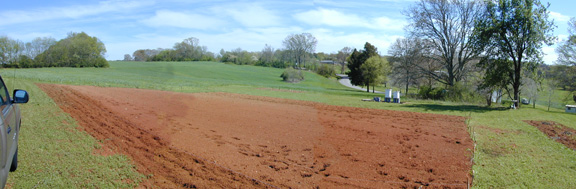
Hive 1 got a new queen yesterday. Jim Brown and I opened the hive a couple of weeks ago and decided that the evidence was there was either no queen or that she was slowing down so much, she simply wasn't producing. I called Coley O'Dell, master beekeeper, and ordered one. He suggested that when she showed up and we were able to install her, we should take a frame of brood cells from Hive 2 and put it in Hive 1 to give it a bit of a boost.
The new queens that Coley had ordered showed up this week, and Jim and I did what Coley suggested last night. We looked through Hive 1 and could not find the queen or any evidence that she was around -- no brood cell. When we were confident she wasn't there, we opened Hive 2 and found a frame that had a lot of brood. We took a frame from Hive 1 and exchanged it. Then we put a spacer between the first box and second box of the hive and placed the queen -- still in her protective box, of course -- in between the two boxes.
All this was done during the late afternoon and some fairly stiff winds. Bees dislike wind and tend to get very ill if exposed to it too much. I must say, however, that the bees did very well last night and were generally cooperative with what we had to do.
Jim and I will take a look inside the hive in a few days to make sure the queen is out of her box and has been accepted by the hive.
Meanwhile, after some rain and a bit of wind, today (Saturday, April 12) was spectacular on the farm. The sky was blue with lots of high clouds, the temperatures stayed in the 60s, and the wind whipped around all day. Sally and I did a lot of yard work -- mowing, cleaning, trimming, raking, etc. I also did some tilling and evened out the garden to some extent.
The forecast for early next week is cold, nearly freezing weather, so that precluded putting much stuff in the garden. Still, I couldn't resist stopping by the farmer's coop this morning and getting another variety of potatoes -- Kennebec red. Here's what the Washington State University web site has to say about Kenebecs:
Kennebec - Tubers are "elliptical to oblong, medium thick; smooth creamy buff skin; shallow eyes; white flesh.... High yielding fast growing variety, widely adapted. Requires close planting (15 to 20 cm between plants) and vine killing to avoid producing oversized and rough tubers. Excellent storage quality. Long dormancy period. High total solids." Primary uses: boiling, baking, chipping, and frying.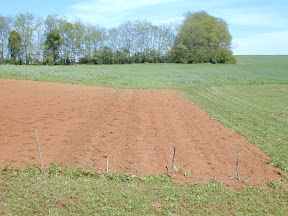 I bought a couple of pounds, which took up only about a third of Row 4. So this is how the garden lines up to date:
• Row 1: potatoes -- bananas, Red Russet, French fingerling (March 31)
• Row 2: peas (March 31); potatoes -- Yukon gold (April 7)
• Row 3: lettuce; red onions (April 7)
• Row 4: potatoes -- Kenebec (April 12)(eastern third)
These rows are pictured to the left (looking east), and it's apparent that not much is happening above ground right now. I hope the right things are going on below the surface.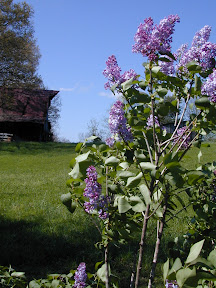 Now that it is mid-April, some of the more beautiful blooms are appearing. The dogwoods are out and about to peak. We have a lilac bush in the back yard, and that is blooming now for the third year in a row after years of being dormant. I have seen the first bachelor buttons and buttercups in the pasture. It's a wonderful, colorful time of the year, and a clear day like today makes you appreciate it even more.
And to add to the joy, baseball season is in full swing, and the Cardinals, surprisingly, are winning.
Later in the afternoon, after I had finished with the work, I walked around some with the camera. There is always something to take a picture of, so I tried to include a lot of what I had just talked around. Everything is in the slideshow below.
Enjoy.

Sunday, April 6, 2008
Planting - first report
As the grass, bushes and trees turn the new, clean green that only spring can offer, it's time to start putting things into the ground. We started last Monday (March 31) with a row of potatoes and a half a row of peas. In a separate patch, we put in some daylilies at the same time.
The potatoes were bananas, French fingerlings and Russets that I had ordered from Romingers in Colorado. I particularly wanted the French fingerlings. We started buying those from a farmer at the Abingdon, VA, farmer's market several years ago, and they are one of the best things I have ever put in my mouth. I have wondered since then if I would ever be able to grow anything like that. Our potatoes didn't come up last year because we planted them too late, and they were done in by the drought. We shall see this year.
That was all that we were able to do this week because of an exceptionally busy schedule at the University and because it has rained just about every day since then. We are not having a drought so far this year, although the predictions for later this summer are that it's going to be hotter and drier than normal. That doesn't sound good. But up to this point, we have had lots of rain, and we are enjoying that. A couple of days of dry weather wouldn't hurt because we have some other things to get into the group. Some of the daylilies we set out came from the Biltmore House in Asheville, NC. We toured the place in March with our friends the Rables, and we bought some of the bulbs from the garden shop. We purchased some other locally and set out about 15. Daylilies are supposed to be practically maintenance-free. The ones we had in Tuscaloosa certainly were. We have created a separate patch for them in the garden. They've already popped their heads out of the ground, and I am anxious to see how they do. (The picture at the right was taken in one of the greenhouses of the Biltmore House.)
We drove the truck to the back of the farm this afternoon and dug up some iris that had grown there for several years. We're going to put those in the daylily patch and see if they bloom and spread as they should. We haven't gotten those into the ground yet because despite a beautifully clear day today, it's still too muddy to get into the garden.
On another front, I completed a painting of the Gorgas House on the University of Alabama campus this year to donate to a student organization's auction. You can see it here.
Update, Monday, April 7: The garden continues to grow. After a couple of dry days, the mud has been chased below the surface, and we were able to get a few more things in the ground. So, this is how things are shaping up so far:
Row 1: potatoes -- bananas, Red Russet, French fingerling (March 31)
Row 2: peas (March 31); potatoes -- Yukon gold (April 7)
Row 3: lettuce; red onions (April 7)
We also put in some of the iris that we dug up on Sunday. We placed those in the daylily patch along with some freesia.
Subscribe to:
Posts (Atom)