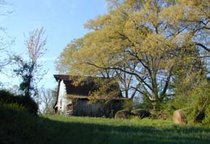
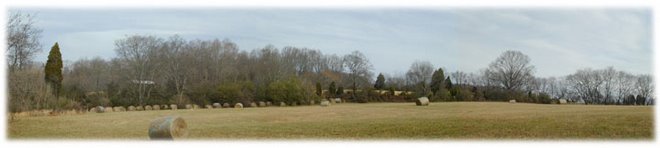
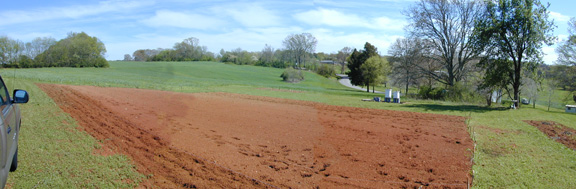
The third week in March has grown into Potato Planting Week here on the farm in East Tennessee, and today was unofficially Spud Day. The first of the seed potatoes went into the ground.
(Unfortunately, all we have is the "after" pictures, none "during." The crew does not always take kindly to having a photographer on the scene while work is being done, and I did not want to risk a work stoppage.)
We put in more than 130 pounds of potatoes -- a few more than 80 pounds in the potato garden, east of the vegetable garden which John operates. Then we put in 50 pounds in the first rows of my part of the vegetable garden. For the record, here's how they went in:
Row 6 (east to west): Yukon Gold; mixture
Row 7: Red Gold; Russian banana (fingerlings)
Row 8: Russian bananas
Row 9: French fingerlings
Row 10: Peanut fingerlings
As usual, we ordered our seed potatoes from Roninger's out in Colorado, and our hopes are high. Roninger's has good products and we have been very satisfied with their service.
The weather for planting today was nearly perfect: dry, cloudy and temps in the mid 50s. We will remember this day when we are harvesting in July.
This is actually been a two-day process to get the garden read (and protected) for planting. Cattle from the field next to ours have been getting through the fences, and they do every spring. Unfortunately, the owner of the cattle figures they will be back, no matter where they wander, and doesn't see his job as keeping the cattle in. Consequently, I have to work to the keep the cattle out.
So, yesterday morning starting with my doing some fence mending. It's just one of the things I've learned to do since we have been on the first. I found a couple of spots where the cattle were getting through and had to string some new lines of barbed wire to discourage them.
This will probably not be the last time I have to go through this process.
But for now, the cattle are on the other side of the fence, the potatoes are in the ground, spring is in the air and all seems to be well.
Saturday, March 19, 2011
Spud Day on the farm

Tuesday, May 4, 2010
The beginning of the season
Well, we are considerably past the beginning of the season, and I am considerably behind in the posts that I wanted to put here, but I will try to catch up.
Here's a bullet-point list of items that I will be posting more about:
- A potato garden now exists with some 1,800 row feet of potatoes.
- New bees have arrived and new hives have been started.
- Topbar hives are beginning to appear around the place. How did that happen? (Much more later.)
- House additions and renovations are complete, including a garage that changes the look of the place entirely.
- Everything (except the bees) seemed to survive the winter, including the 17 semi-dwarf apple trees that we set out in November.
- I am becoming anti-apiary. I'll explain later.
- I read most of Gene Logsdon's The Contrary Farmer over the winter and feel well on my way to becoming a contrary farmer.
- Tractor-shopping is in my near future.
- Corn, beans, cucumbers, potatoes -- all up.
- Cardinals are off to an excellent start. Summer should be fun.
- Lots of unread books in the stack.
As I said, more later.
Monday, April 27, 2009
Late-night delivery of nuc hives; the garden is taking shape
• A "bee-running" expedition on Saturday nets us four new hives.
John said it felt like we were running moonshine.
Saturday night, somewhere in the darkness of Blount County, we picked up four nuc hives of bees from Coley Odell, who had put them together for us. The hives were strapped down in the back of the truck and made it to the farm. We pulled them off the truck and set them up on their hive stands, stuck an extra box on top of each, put some feed on the front, and then waited for them to wake up on their new homes on Sunday morning.
It all went well, and now there are six hives in the fold, four for me and two for John.
We took a look inside the hives on Sunday afternoon. Coley had done his work well, and the nuc hives that John had bought and saw plenty of brood cell and no problems.

We also looked inside the hives of package bees that I installed three weeks ago, and we found much that was comforting -- lots of brood cell and even some nicely capped honey. (See the picture to the right.) I decided to put a queen excluder on top of the third box and a box of drawn comb on top of that. Now that the feeders are off, that hive is ready to make honey.
The situation was essentially the same with the second hive of packaged bees, although for some reason there seem to be fewer bees at work. Still, there were plenty with brood cell, larva, pollen and honey. I slipped a deep box of mostly drawn comb on top of the bottom box to see if the bees would go down and start working it. I also put a queen excluder on top of the third box and made the top box the hive's first honey super.
Both hives give every indication of being productive with no apparent tendencies to swarm, so I will check them this weekend and see what kind of progress they are making.
Meanwhile, the garden is coming under control.
I spent a good bit of time Sunday taking up the string markers where where the rows of plants have become visible and tilling out the weeds where it was safe to do that. To me, that says the garden is beginning to grow much as I had planned it, and the soil, the plants, the water and God's miracles of biology have to take over. I become more of a secondary player in this drama.
John and I are planning a second raised bed -- this one to be filled with herbs -- and we took advantage of my master carpentry skills (ha!) to put together with some old wood from the smokehouse and the barn. As long as you're not finicky about the way the wood looks, the fact that there might be a few 40-year-old rusty nails here and there in it, and the sizes to which the boards need to be cut, that kind of wood is perfect for our project.
This evening after supper, Sally and I trekked back to the garden where we put some okra and cucumber see in the group, dug the holes for the feet of the new raised bed box and put that into the ground.
So, here's how the garden is shaping up (I have renumbered the row, beginning at the top -- north -- end):
Row 1: yellow corn
Row 2: yellow corn
Row 3: yellow corn
Row 4: beans
Row 5: beans
Row 6: horticulture beans (planted Saturday, April 25)
Row 7: white corn (to be planted next week)
Row 8: white corn (to be planted next week)
Row 9: white corn (to be planted next week)
Row 10: tomatoes
Row 11: beans (striped half runners)
Row 12: okra, cucumbers
Row 13: onions, potatoes (planted March 22)
Row 14: potatoes (Red russets, French fingerlings, Yukon gold from Colorado)
Row 15: potatoes (legacy)
Row 16: peas, potatoes (I may put something else in between these two)
And, finally, as usual: pictures, taken Sunday, April 26.
Wednesday, April 8, 2009
A dry garden and more potatoes
The garden dried out enough over the weekend so that we able to put in some potatoes on Sunday (April 5). So, for the record, here's what we planted:
Row 3: French fingerings, Red Russets, Yukon Gold
Row 2: legacy potatoes (these are a mix of those left from last year)
Row 1: [unplanted], legacy, Red Pontiacs
The west part of row 1 still has some room, and if I can find some potatoes I like, I'll put some more in to fill out the row.
Here's what the Washington State University comprehensive description of potato varieties says about Red Pontiacs:
Tubers are "oblong to round; smooth, sometimes netted, red skin; medium deep eyes; white flesh.... High yielding variety of attractive appearance, widely adapted (especially to muck soils). Some drought resistance, bruises easily; susceptible to air cracking at harvest. Low total solids. Good storability, medium dormancy."And more about this variety can be found at the Red Pontiac page of the Canadian Food Inspection Agency.
I am interested to see how the potatoes from last year (which I have named "legacy" potatoes) do. They are relatively small and shriveled, but they came from stock that produced well last year, so I have some hope for them. Most of them look like Russian bananas, but we'll see.
Because of the bad weather, we have been late getting these things into the ground, so it will be well into July before we can see how well they are doing. We harvested the potatoes last year a little too early (July 4), and I am determined to wait until at least the end of July before digging them up. Which is not to say I won't be sneaking a few new potatoes out of the garden toward the end of June.
In any event, it's good to have things in the ground.
Cold weather for the past couple of nights gave us a scare, more for the new bees than anything else. But it never got much below freezing, and it looks like today will be sunny with temps climbing to the 60s.
Are we done with winter yet?
Sunday, March 22, 2009
Blessing the sprouting seed -- with work and a bit of prayer
First Day of Spring 2009
Jim Stovall on Vimeo
(Music by Frank Story)
Finally, some quality time in the garden this weekend.
It's been a rainy winter (I have undoubtedly mentioned that before now), and since December the rain and inclement weather has occurred on the weekends more than not. Getting into the garden, or even outside, to do most anything has been frustrating. Even last weekend, the first weekend of our spring break, was rainy and cold.
But we've now had several days of dry weather, and Friday it was good enough to walk across the plowed dirt of the garden without getting bogged down. And that's exactly what I did. I had been anxious to start marking off the rows of the garden and pulling the string, which will keep me straight, and I was able to accomplish much of that on Friday.
Saturday was an all-day writing workshop in Knoxville with friends Cyn Mobley, Katrina Belcher and Bryce Anderson, so there was no garden work there.
But today, it was glorious.
Onions
Last year, the first thing that went into the ground was potatoes, and I didn't do that until the last day of March. This year, getting serious about onions gave me the excuse to start a bit earlier.
I planted more than 50 white onion sprouts and near 100 red onions (Row 4) and watered them thoroughly. Digging the ground with the hoe to make the rows and then moving the dirt around to get the sprouts in and standing straight felt awfully good. Onions have the advantage of your being able to see them immediately. You don't have to wait for them to "come up."
So, the garden has begun.
(The pictures on the right were taken today after the work was done. The audio slide show above was done on Friday.)
Potatoes
I decided to finish out Row 4 with some potatoes that I had left over from last year. It may be a bit early to plant them, but I just couldn't help it. The potatoes I put into the ground are of various types, and they all had sprouts on them, so I can see many of them even after I had covered them with dirt.
I am curious to see what will happen with these potatoes. They came from Colorado last year and did very well and then stayed in the basement all winter long. They are somewhat shriveled, which is not preferable for what you want to put in the ground, but there is nothing I could do about them.
If these potatoes do well at all, they should be a little early because they have such long and healthy sprouts. At least, that's what I have read.
More on potatoes later.
The main point is, they're in the ground and doing the Lord's work.
The Lord's work
And speaking of the Lord's work, my friend Chuck Warnock pointed to an interesting site the other day: In-formatio.
The site is the work of Michael Rich, a guy who lives in North Carolina on the other side of the mountains from me, and Michael describes his site as one that is a "space to make ongoing observations about my life of faith in formation. From my perspective, we are always in formation and in the process of being transformed."
On Saturday, Michael included the Blessing of the Sprouting Seed, which comes from The Rural Life Prayerbook (published in 1956) from the National Catholic Rural Life Conference. It's beautiful:
Let us pray.
We ask and beg of You, Lord, to bless this sprouting seed. Warm it with the gentle breath of soft winds, make it fruitful with dew from heaven, and be so kind as to bring it to its fullest maturity for the good of our souls and bodies, through Christ our Lord.
Amen.
And all the people said, Amen.
Sunday, March 8, 2009
First light at the end of winter's long tunnel
The first light at the end of winter's long, cold and wet tunnel appeared this weekend. With temperatures in the 60s and no rain, it was the first time this year I've had the chance to do any real work in the garden and elsewhere.
So, I took advantage.
The first thing I did Saturday morning was sort the potatoes. I had about 15 pounds of potatoes left over from last year's harvest. They had been stored in the basement, and nearly every one of them, even the very smallest, had developed sprouts. I checked with the good folks at Ronniger's in Colorado, where I had ordered them last year, to see if there was any reason not to put those in the ground this spring.
There isn't. So, Saturday morning I sorted.
I ended up with what will be enough seed potatoes for a row of banana ("the superstar of fingerling potatoes," according to Ronniger's) potatoes. I'll also have enough Russets and various others -- French fingerlings, Yukon gold -- for another row. This morning I ordered enough from Ronniger's to fill a third row with Russets, French fingerlings and Yukon Gold.
The Russets and French fingerlings did very well last year, so I thought I would go with what has worked before. The Yukon golds were bought locally and didn't produce so well, so I thought I would give them another shot with the Colorado imports.
Growing potatoes was one of the great gardening thrills I had last year, and I hope I can duplicate it this year.
The garden
I had mentioned here before that Kenneth, the fellow who plowed my garden last fall, got enthusiastic and just about doubled the size of the plot. I got a taste of just how big he had made the garden on Saturday when I pulled out the tiller and started breaking up the ground.
The garden is now 125 feet long and about 75 feet wide. That's a very long row. I tilled for about an hour and got about a third of the plot turned over. Much more tilling in my near future.
The bees
I have been reluctant to post much about the bees lately because disaster struck about three weeks ago. We had a brief warm spell, and I had decided to put some Apistan strips in the two hive that I had left, but when I opened them up, there was nothing left but a few dead bees. Both hives had died out completely.
My guess, confirmed by my friend Jim, was that the winter was simply too long and cold and they starved to death.
This was a huge disappointment because I believe both hives to be healthy and active, and I had been looking forward to just this time so I could shift the boxes around and get them ready for the spring. Instead, I have had to call Howard and reserve some boxes of bees that he will be bringing on April 4.
The one slightly silver lining in all this is that I have plenty of drawn comb -- pure gold for the beekeeper -- so when the new bees show up, they shouldn't have any trouble getting started. I still look forward to a honey harvest in July.
The coming of spring
The first paragraph of this post described winter as long, cold and wet. The good thing about that was the "wet" part. East Tennessee made a valiant attempt to climb out of its drought this winter with goodly amounts of rain in November, December and January. The ground is moist, and nature seems anxious to take off in these last three weeks before spring officially descends.
Sunday, July 6, 2008
Potatoes on the Fourth
We harvested our first crop of potatoes on July 4. It seemed like an appropriately American thing to do, and it turned out to be more exciting than a fireworks show.
I have loved potatoes since I was a small child and have secretly harbored a desire to grow them for a long time. That desire was renewed a couple of years ago when we lived in Virginia and visited the Abingdon farmers market regularly. Later in the season, a fellow would show up with a potato I had never seen before -- a small, longish white potato called a French fingerling. We roasted them as he suggested and got hooked.
The guy who sold us the potatoes told me he had ordered the seed potatoes from Colorado, but they obviously took to the local climate, and I told myself then, "If you ever get the chance, those are the kind you are going to grow."
Of course, there are many kinds of potatoes, and to limit yourself to one kind is as unwise as limiting yourself to one kind of ice cream. So, early this year when I started planning the garden, I found Ronniger's in Colorado as a source for seed potatoes. I started through their web site and got dazzled by the many kinds and varieties they had available. They did have French fingerlings, and that was where I started.
Now, I should state at this point that I knew nothing -- NOTHING -- about preparing, planting or digging potatoes. My ignorance was absolute. (Had someone told me that potatoes grew on potato trees, I probably would have believed them.) But I was determined. I read what I could find about the process. I tried to ask questions in a way that wouldn't reveal ignorance or stupidity. I ordered the potatoes I wanted -- French fingerlings, Burbank russets and Russian bananas (some kind of cousin to the fingerling, I think) -- from Ronniger's. One pound of each. No use taking simple failure to outright disaster, I reasoned. I found a couple of other varieties (Yukon gold and Kennebec reds) locally. All told, I had about six pounds of potatoes.
I put them in the ground about mid-March.
I watched and waited. After a couple of weeks, nothing was happening, so I asked a friend who knew something about this. Be patient, he said. They'll show up before long.
He was right. They started poking their heads through the soil after about three weeks. Then they grew and grew. By the end of April they were full and healthy, and by the late of May, they were nearly chest high. Their few blossoms were beautiful (see the picture below). I mounded the soil around them as I was instructed by my reading. I mulched and composted -- not too much, but enough to keep them going. (The only slow ones were the Yukon golds, for reasons I have not discerned. They may be slow, or they may not have been good seeds to begin with.)
All this was great. But there was a lingering question: Were there any potatoes under the big, bold, beautiful plants?
As June approached, I would not resist the temptation. I dug gingerly around one of the mounds, and VOILA! Potatoes! Beautiful, wonderful potatoes.
I have been digging and poking around for a month now, but we decided that the full harvest must be done soon. I had been reading about the possibility of a fall crop, so I wanted to get this first crop finished. I designated July the Fourth as the appropriate and memorable day for the Great Potato Dig on Frog's Farm.
And so it was.
We (Sally, Jane, Frank and Owen) spent an hour of the early evening pulling up potato vines and tossing potatoes into the buckets and wheelbarrow. My six pounds of seed potatoes produced well more than 50 pounds of potatoes (maybe as much as 60 pounds considering all the robbing I had been doing in June.) I had spent the last week constructing a potato shelf that we could set in the basement and use for storage. I had no idea how big it should be, so I just guessed and used the wood that I had on hand. As it turned out, the shelf was just right, and it holds all of the potatoes with a little room to spare.
So, the potatoes are in.
Now it's on to the second crop. I have ordered five pounds of Canelas, two pounds of German butterballs, and one pound of Golden Sunburst (don't you just love those names), and I plan to get them into the ground this week. Then we can look forward to September potatoes.
Update: I put in the new crop of potatoes yesterday (Monday, July 7). All of row 15 was taken up by the Canelas, and the German butterballs and Golden Sunburst share row 14. Many of the pieces had begun to sprout small shoots, so I am anxious to see how they do when they are in the ground. We need rain very badly.
Wednesday, May 7, 2008
A trip to Monterey - in Loudon County
- Monterey Mushrooms - one of East Tennessee's hidden gems, and a great place for the gardener.
East Tennessee is full of discoveries waiting to be discovered, and wife Sally and I found one on Tuesday -- the Monterey Mushroom Company in Loudon County.
And why go to the Monterey Mushroom Company? Not for the mushrooms. You can buy those at the local grocery story.
If not mushrooms, then what? Compost.
Monterey Mushroom has compost, mountains and mountains of compost. And the friendly folks there will sell you a truckload for $25. All you need is a truck with a good set of springs, and the ability to stand strong odors. The place wreaks.
View Larger Map
Our friend Jim Brown of Honey Rock Herb Farm in Louisville told us about the place a few weeks ago, and we had been meaning to drive down there ever since. Tuesday we got our chance. We made our way over to Highway 11 and then down through Lenoir City and five miles after that the town of Loudon. A couple of miles past the center of Loudon, Highway 72 intersects Highway 11, and you make a right back toward Interstate 75. Just after you cross over the Interstate, you see a big Honda plant on the right, and the next thing on the right is Monterey Mushrooms.
The guy at the gate directed us around to the back, and as we were driving back there Sally rolled up the windows and turned on the AC. Too late. We just had to live with the smell. In the back, a very friendly guy took our order for year-old compost (this stuff is ready to spread onto your garden) and told us to drive further up the hill -- which must be what compost heaven looks like.
When we got to the designated spot, we waited for a few minutes along with a couple of other folks. A guy with a front-loader made his way up the hill and proceeded to dig into one of several mountains of compost (some had to be 30 or 40 feet high) and load us up with all that we could carry.
The compost is thick, a bit moist and pretty heavy, so you have to be careful not to overload the truck. We paid at the gate, and it was somewhat slow-going back to Maryville, but we made it. We spent yesterday and today spreading the stuff throughout the garden.
Twenty-five bucks for the compost, a few bucks for the gas, a pleasant drive and a healthier garden. Not bad for a Tuesday morning in May.
And speaking of the garden . . .
We have put in some tomato and pepper plants and are growing lettuce, peas, cucumbers, and okra from seeds. The cucumber seeds I planted have been abundant in sprouting, so this evening I dug up a few and transplanted them to a different row just to see if they would make it. I will have to thin them out anyway, so it won't be a great loss.
At the top of the garden are three healthy rows of candy corn and three rows of beans.
But the pride of the garden so far is at the bottom where a row of potatoes reside. They were ordered from Colorado and include some fingerlings. Everything has come up and is big and green and leafy. A sight to behold.
Pictures soon.(see below)
Note: We did a little research on Monterey Mushrooms before we ventured into deepest Loudon County and found that it is one of the major companies in the county with more than 500 employees. Many of the workers are Mexican, and you can note the Hispanic presence in the area by the many signs in Spanish that you see along the way. If our country ever decides to get sensible about an immigration policy -- and stop cowering behind the idea of a "fence" -- it might look to Loudon County to see how our neighbors south of the border are making our lives, and theirs, a little better.
Update: Pictures from this morning (Thursday, May 8). The white blossoms are the blackberry vines. The blackberries should be ready in about six weeks.
Sunday, April 27, 2008
Watching the garden grow
The expression "like watching the grass grow" describes something that is slow and boring.
So why do we get so excited at watching our garden grow -- literally. The corn and beans that we set out a little more than a week ago have started to pop up and are making a distinct row. The potatoes that we first put in -- the ones we ordered from Colorado -- are nice leafy plants, and the lettuce is beginning to look like lettuce, albeit very small. We even saw some evidence of my red onions coming through the grown.
And this is exciting?
You bet it is. It's the miracle of growth -- something we take for granted most of the time.
But in our garden, we're partially responsible for it. And that makes the heart beat just a bit faster.
Meanwhile, yesterday we put our a couple of additional things, so now the lineup looks like this:
- Row 1: potatoes -- bananas, Red Russet, French fingerling (March 31)
- Row 2: peas (March 31; replanted April 22); potatoes -- Yukon gold (April 7)
- Row 3: lettuce; red onions (April 7)
- Row 4: Cherokee Purple tomatoes (western third, April 22); cucumbers (middle third, April 26); potatoes -- Kenebec (April 12)(eastern third)
- Row 5: Pepper plant (western end, April 26); okra (seed, eastern third, April 26)
- Row 6: Red and yellow peppers (seed, eastern third, April 26)
- Row 7: Tomato plants (western end, April 26)
- Row 13: Beans, half-runners (April 18)
- Row 14: Peanut beans (ordered); peanut beans (horticulture) (April 18)
- Row 15: Peanut beans (local) (April 18)
- Row 16: Candy corn (April 18)
- Row 17: Candy corn (April 18)
- Row 18: Candy corn (April 18)
The plan (as if we had one): Rows 10-12 will be white corn, to be planted well have the yellow corn is up and going to prevent cross pollination. The eastern have of rows 7-9 will be pumpkins to be planted in May or sometime. We'll fill in with other things as we find them.
Saturday, April 12, 2008
A new queen for Hive 1
Hive 1 got a new queen yesterday. Jim Brown and I opened the hive a couple of weeks ago and decided that the evidence was there was either no queen or that she was slowing down so much, she simply wasn't producing. I called Coley O'Dell, master beekeeper, and ordered one. He suggested that when she showed up and we were able to install her, we should take a frame of brood cells from Hive 2 and put it in Hive 1 to give it a bit of a boost.
The new queens that Coley had ordered showed up this week, and Jim and I did what Coley suggested last night. We looked through Hive 1 and could not find the queen or any evidence that she was around -- no brood cell. When we were confident she wasn't there, we opened Hive 2 and found a frame that had a lot of brood. We took a frame from Hive 1 and exchanged it. Then we put a spacer between the first box and second box of the hive and placed the queen -- still in her protective box, of course -- in between the two boxes.
All this was done during the late afternoon and some fairly stiff winds. Bees dislike wind and tend to get very ill if exposed to it too much. I must say, however, that the bees did very well last night and were generally cooperative with what we had to do.
Jim and I will take a look inside the hive in a few days to make sure the queen is out of her box and has been accepted by the hive.
Meanwhile, after some rain and a bit of wind, today (Saturday, April 12) was spectacular on the farm. The sky was blue with lots of high clouds, the temperatures stayed in the 60s, and the wind whipped around all day. Sally and I did a lot of yard work -- mowing, cleaning, trimming, raking, etc. I also did some tilling and evened out the garden to some extent.
The forecast for early next week is cold, nearly freezing weather, so that precluded putting much stuff in the garden. Still, I couldn't resist stopping by the farmer's coop this morning and getting another variety of potatoes -- Kennebec red. Here's what the Washington State University web site has to say about Kenebecs:
Kennebec - Tubers are "elliptical to oblong, medium thick; smooth creamy buff skin; shallow eyes; white flesh.... High yielding fast growing variety, widely adapted. Requires close planting (15 to 20 cm between plants) and vine killing to avoid producing oversized and rough tubers. Excellent storage quality. Long dormancy period. High total solids." Primary uses: boiling, baking, chipping, and frying.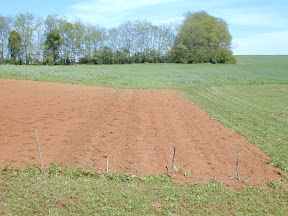 I bought a couple of pounds, which took up only about a third of Row 4. So this is how the garden lines up to date:
• Row 1: potatoes -- bananas, Red Russet, French fingerling (March 31)
• Row 2: peas (March 31); potatoes -- Yukon gold (April 7)
• Row 3: lettuce; red onions (April 7)
• Row 4: potatoes -- Kenebec (April 12)(eastern third)
These rows are pictured to the left (looking east), and it's apparent that not much is happening above ground right now. I hope the right things are going on below the surface.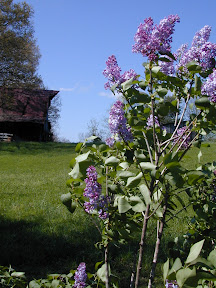 Now that it is mid-April, some of the more beautiful blooms are appearing. The dogwoods are out and about to peak. We have a lilac bush in the back yard, and that is blooming now for the third year in a row after years of being dormant. I have seen the first bachelor buttons and buttercups in the pasture. It's a wonderful, colorful time of the year, and a clear day like today makes you appreciate it even more.
And to add to the joy, baseball season is in full swing, and the Cardinals, surprisingly, are winning.
Later in the afternoon, after I had finished with the work, I walked around some with the camera. There is always something to take a picture of, so I tried to include a lot of what I had just talked around. Everything is in the slideshow below.
Enjoy.
Sunday, April 6, 2008
Planting - first report
As the grass, bushes and trees turn the new, clean green that only spring can offer, it's time to start putting things into the ground. We started last Monday (March 31) with a row of potatoes and a half a row of peas. In a separate patch, we put in some daylilies at the same time.
The potatoes were bananas, French fingerlings and Russets that I had ordered from Romingers in Colorado. I particularly wanted the French fingerlings. We started buying those from a farmer at the Abingdon, VA, farmer's market several years ago, and they are one of the best things I have ever put in my mouth. I have wondered since then if I would ever be able to grow anything like that. Our potatoes didn't come up last year because we planted them too late, and they were done in by the drought. We shall see this year.
That was all that we were able to do this week because of an exceptionally busy schedule at the University and because it has rained just about every day since then. We are not having a drought so far this year, although the predictions for later this summer are that it's going to be hotter and drier than normal. That doesn't sound good. But up to this point, we have had lots of rain, and we are enjoying that. A couple of days of dry weather wouldn't hurt because we have some other things to get into the group. Some of the daylilies we set out came from the Biltmore House in Asheville, NC. We toured the place in March with our friends the Rables, and we bought some of the bulbs from the garden shop. We purchased some other locally and set out about 15. Daylilies are supposed to be practically maintenance-free. The ones we had in Tuscaloosa certainly were. We have created a separate patch for them in the garden. They've already popped their heads out of the ground, and I am anxious to see how they do. (The picture at the right was taken in one of the greenhouses of the Biltmore House.)
We drove the truck to the back of the farm this afternoon and dug up some iris that had grown there for several years. We're going to put those in the daylily patch and see if they bloom and spread as they should. We haven't gotten those into the ground yet because despite a beautifully clear day today, it's still too muddy to get into the garden.
On another front, I completed a painting of the Gorgas House on the University of Alabama campus this year to donate to a student organization's auction. You can see it here.
Update, Monday, April 7: The garden continues to grow. After a couple of dry days, the mud has been chased below the surface, and we were able to get a few more things in the ground. So, this is how things are shaping up so far:
Row 1: potatoes -- bananas, Red Russet, French fingerling (March 31)
Row 2: peas (March 31); potatoes -- Yukon gold (April 7)
Row 3: lettuce; red onions (April 7)
We also put in some of the iris that we dug up on Sunday. We placed those in the daylily patch along with some freesia.