Showing posts with label wildflowers. Show all posts

Monday, November 24, 2008

Sheep on the farm (not my farm)


Nick, a friend who lives down the road from the farm, told me the other night that he is thinking seriously of putting sheep on his farm. Nick is fully retired and has lots more acreage than we do, and his place can probably handle it.

I had been thinking about sheep -- but certainly not tempted to do what Nick is doing -- when I ran across this article, Shear Delight, in the Tennessee Farm Bureau's Tennessee Home and Farm magazine.

The article describes Beth Collier and Steve Shafer, a couple near Charlotte, Tenn., who raise sheep, selling the lambs and shearing the basic herd, on their 56-acre farm. They say there is a ready market for raw wool.

Shafer and Collier (the couple in question) shear the sheep together each spring, worm them, trim their feet and assist with lambing when necessary. The couple processes much of the wool by hand – washing, combing and carding it into a soft, fluffy texture. To help lighten their load, they’ve recently started shipping hundreds of pounds to a processing mill in Oklahoma.

Collier and Shafer sell roving (wool that has been washed, combed and carded) and fleece (a year’s worth of unprocessed wool from one sheep) at festivals and from a small shop on their farm.

“Our primary market is other spinners,” Collier says. “Most spinners cannot also raise their own sheep, and they may not have any interest in it.”

In addition, Collier and Shafer raise flowers that are used to dye the wool.

Shafer and Collier grow their own herbs in a greenhouse, and they harvest wildflowers and raise traditional dye plants – including chicory, woad, amaranth, marigold, zinnia and black-oil sunflower – to create their own natural dyes.

“It’s a good excuse to raise flowers,” Collier says. “I love gardening, and when your flowers can also dye your wool and yarn, it combines two of your loves into one. It’s kind of a macho thing to be able to say, ‘I raised the sheep, I sheared the sheep, I washed the wool, I spun the wool, I dyed it with flowers I picked – and I crocheted a sweater or shawl.’”

They have quite an operation, and I wish them the best. As they say -- and I certainly believe -- it's a lot of work.


Saturday, April 12, 2008

A new queen for Hive 1


Hive 1 got a new queen yesterday. Jim Brown and I opened the hive a couple of weeks ago and decided that the evidence was there was either no queen or that she was slowing down so much, she simply wasn't producing. I called Coley O'Dell, master beekeeper, and ordered one. He suggested that when she showed up and we were able to install her, we should take a frame of brood cells from Hive 2 and put it in Hive 1 to give it a bit of a boost.

Photobucket
The new queens that Coley had ordered showed up this week, and Jim and I did what Coley suggested last night. We looked through Hive 1 and could not find the queen or any evidence that she was around -- no brood cell. When we were confident she wasn't there, we opened Hive 2 and found a frame that had a lot of brood. We took a frame from Hive 1 and exchanged it. Then we put a spacer between the first box and second box of the hive and placed the queen -- still in her protective box, of course -- in between the two boxes.

All this was done during the late afternoon and some fairly stiff winds. Bees dislike wind and tend to get very ill if exposed to it too much. I must say, however, that the bees did very well last night and were generally cooperative with what we had to do.

Jim and I will take a look inside the hive in a few days to make sure the queen is out of her box and has been accepted by the hive.

Meanwhile, after some rain and a bit of wind, today (Saturday, April 12) was spectacular on the farm. The sky was blue with lots of high clouds, the temperatures stayed in the 60s, and the wind whipped around all day. Sally and I did a lot of yard work -- mowing, cleaning, trimming, raking, etc. I also did some tilling and evened out the garden to some extent.

The forecast for early next week is cold, nearly freezing weather, so that precluded putting much stuff in the garden. Still, I couldn't resist stopping by the farmer's coop this morning and getting another variety of potatoes -- Kennebec red. Here's what the Washington State University web site has to say about Kenebecs:

Kennebec
- Tubers are "elliptical to oblong, medium thick; smooth creamy buff skin; shallow eyes; white flesh.... High yielding fast growing variety, widely adapted. Requires close planting (15 to 20 cm between plants) and vine killing to avoid producing oversized and rough tubers. Excellent storage quality. Long dormancy period. High total solids." Primary uses: boiling, baking, chipping, and frying.

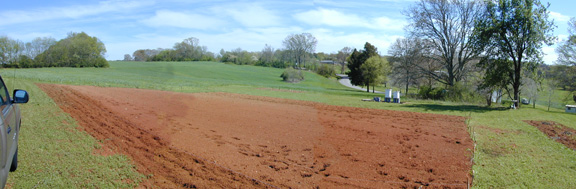
I bought a couple of pounds, which took up only about a third of Row 4. So this is how the garden lines up to date:
• Row 1: potatoes -- bananas, Red Russet, French fingerling (March 31)
• Row 2: peas (March 31); potatoes -- Yukon gold (April 7)
• Row 3: lettuce; red onions (April 7)
• Row 4: potatoes -- Kenebec (April 12)(eastern third)
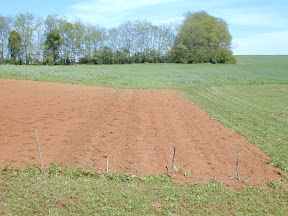
These rows are pictured to the left (looking east), and it's apparent that not much is happening above ground right now. I hope the right things are going on below the surface.

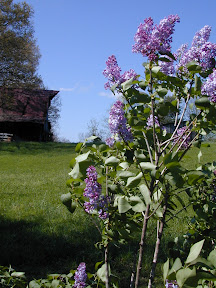
Now that it is mid-April, some of the more beautiful blooms are appearing. The dogwoods are out and about to peak. We have a lilac bush in the back yard, and that is blooming now for the third year in a row after years of being dormant. I have seen the first bachelor buttons and buttercups in the pasture. It's a wonderful, colorful time of the year, and a clear day like today makes you appreciate it even more.

And to add to the joy, baseball season is in full swing, and the Cardinals, surprisingly, are winning.

Later in the afternoon, after I had finished with the work, I walked around some with the camera. There is always something to take a picture of, so I tried to include a lot of what I had just talked around. Everything is in the slideshow below.

Enjoy.

Sunday, April 29, 2007

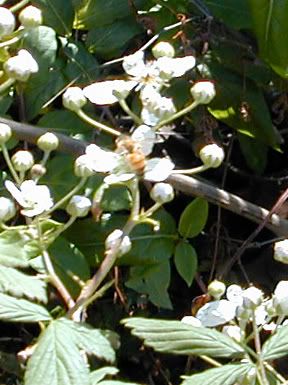
Blackberry blossoms and wildflowers


The farm is entering what I would call its "yellow spring." The pasture is full of yellow buttercups, complemented here and there with groups of white daisies with yellow centers. (The blue bachelor's buttons also add a nice touch.) All the greenery is still new enough to have a yellowish flavor.

The wild blackberry vines are also in bloom. Some of them, as you can see from the photos above, are fairly close to the beehives, and the bees have certainly taken notice. I have been picking the wild blackberries for the last two summers, and each year the crop seems to be more abundant. I have tried to leave area where I know there are vines alone -- not clearing them out or cutting them back. You'll be hearing more about the blackberries as we get into the summer. Right now the bees seem to be having a feast (right).

Sally, Jane and I put out three rows of corn (two yellow and one white) and four rows of beans (two Blue Ribbon and two October) in the garden on Saturday morning. We still plan some pumpkins, tomatoes and one or two other things. We'll see what pops up.

The hives had a busy weekend. Lots of bees were going in and out constantly. They have also taken a couple of jars of feed. I opened both hives last night and found that on the left one (the newer one) the bees still have a tendency to gather under the top cover. They are drawing a good bit of comb up there rather than on the foundations. I'm not sure what to do about that, so I'll have to consult Jim Brown. The other hive is still working away, although there has been more activity in the top box than the lower one. I switched the positions of the boxes, making the top one the lower one, to see if that makes any difference at this point.