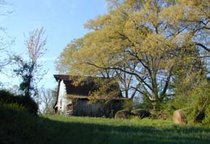
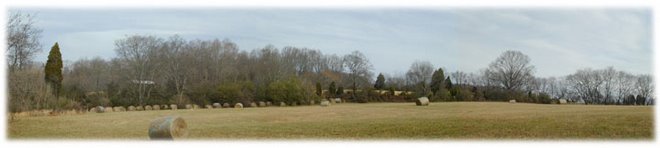
With Venus looking down from the east and fog shrouding the trees, I tramped through the dark and the frost this morning to give the bees some food.
It all felt great.
I had done a quick inspection of my three hives late yesterday -- the first for several weeks -- and found all three with plenty of bees. We have had way too much rain this fall, and I hadn't been able to open the hives for a while. I was wondering if the bees had survived.
They had, fortunately.
So now, for the next three or four weeks, let's hope for semi-warm, dry weather. I plan on feeding them at least through the middle of November, maybe even up through Thanksgiving, just to try to keep their numbers up as they head into the winter. Then I will plan to put food in a top feeder with maybe a grease patty or two and close the hives up for the winter.
One worrisome note was that I found small hive beetles in one of the hives. There's not much to be done about them at this point, but that could cause a problem if the hive continues to weaken.
A weather note: Out of 19 days in October, we have had only seven without rain. We have had nearly three inches this month, all of which has not done the bees much good. Any of the fall blooms run the danger of having the nectar washed out of them. If the next few days stay dry, as they are supposed to, we'll see how the bees feed and if they can make any stores for themselves. We have a patch of buckwheat behind the hives that is in full bloom, and I want to see if the bees go for it.
Monday, October 19, 2009
Early morning feeding of the bees
Tuesday, June 9, 2009
How bees make honey - and how we get it from the bees
How do bees make honey?
I got asked that question on Monday. Here's the answer:
Honey is a combination of nectar and water. The bee does it all.
Worker bees gather nectar, which contains complex sugars, from flowers and store it in a special stomach they have for that purpose. When they bring it back to the hive, the nectar is sucked out of the forager's stomach by a house bee and inside the house bee, the complex sugars of the nectar are broken down into what will eventually be honey.
Once that process is complete, the nectar is placed in the cells of the honeycomb. The moisture content is too high at this point for it to be real honey, so the bees have to work to dehumidify it,
often by simply flapping their wings. One the moisture content of the honey is down to about 19 percent, the bees cap the cell with a wax coating so no additional moisture can intrude.
The beekeeper looks for an entire frame of this "capped honey" when the time come to harvest the honey. The picture at the right shows a frame full of bees. The white stuff on the upper part of the frame is capped honey. When this frame is covered with capped honey, it is pulled from the hive, and a hot knife is used to shear off the caps. Then the frame is put into an extractor, which rotates the frame at a high enough speed so that the honey is thrown out of the cells. The honey collects at the bottom of the extractor and is drained into another container.
The honey is then filtered through something like sheer curtain material. And that's it. No cooking or processing. Local honey, or "raw honey," is this stuff, bought from a local beekeeper.
Commercial honey is "flash heated." That is, it is heated quickly and then cooled. This flash heating will keep it from crystallizing on the store shelf. The flash heating doesn't change the honey; it just eradicates the crystals that might make it crystalize.
Honey should not be refrigerated. Properly contained, it will last for a very long time.
Some of this information comes from the the Michigan State University web site.
Sunday, June 7, 2009
Inspecting the bees in the middle of the honey season
.
Probably the most fun a beekeeper can have is extracting honey from the hives. But since you do that only once, maybe twice, a year, you have to get your pleasures elsewhere.
You can stand there and watch the hive on a day when the bees are active. That can be fascinating.
But pretty soon, you begin to wonder: "What's going on INSIDE the hive?"
And that's the second "most-fun" part of beekeeping: inspecting the hives.
My friend John and I have six hives on the little farm that Sally and I have in East Tennessee. John is just starting and has two hives. I have four. Since it's the middle of the honey season, John and I both stay eaten up with curiosity about what's going on inside the hives, and yesterday we decided to take a look.
(We try to keep the curiosity in check during this time of year because the bees need to concentrate on making honey rather than dealing with a couple of bumbling humans disrupting their ancient routines. Still, inspecting the hives is a necessary part of beekeeping. You're looking for problems -- overcrowding, critter invasions, etc. -- so that you can help the bees along.)
My first hive is a prize-winner. Rather, the queen is some kind of champ. She has been laying from the moment she was released from the cage back in April, and the hive is full of bees, and those bees are storing up a load of honey. In fact, she is making so many bees that I decided that maybe that hive could share with one of the weaker hives. So, one of my goals yesterday was to find a frame or two of brood cell to put in one of the other hives.
I did just that, and the situation in one of the weaker hives, I found, is more dire than I had suspected. Something must have happened to the queen in the weaker hive because there is some brood cell but not very many bees. I put a frame of brood into that hive, but I'm going to have to watch it closely. I may have to get a new queen before long.
My other two hives are doing well. One has lots of brood, which means the queen has been laying and the population will increase substantially before long. I'm still hopeful of getting some honey from those gals. The other hive is coming along but slowly.
John found both of his hives in good shape with lots of bees and lots of brood. Good queens are doing their work for him. He may not get any honey this year because it's his first year, but he should be in good shape going into the fall.
The wet weather has been both good and bad for the bees this spring. The good part is that it has produced plenty of sources of nectar and pollen for the bees to work. The garden is beginning to come in, and they should enjoy the cucumbers, beans, cantaloupes and sunflowers -- among many other things available to them.
But the bees hate wet weather. The rain cuts down on their ability to forage, and it raises the humidity levels inside the hive. That's right. The bees are far more weather sensitive than we realize. When the inside of the hive gets damp, they have to work to dry it out -- the old fashion way, by flapping their wings.
That's because the honey they're making -- in order to be real honey -- has to be less than 19 percent water. It starts out as more than that, and one of the bees' jobs right now is to get it down to that level so it can be capped. Good dry days in June help that process.
So, now that we've had plenty of rain this spring, pray for dry.
And enjoy the video. (You can also find the video on Vimeo.)
Monday, April 27, 2009
Late-night delivery of nuc hives; the garden is taking shape
• A "bee-running" expedition on Saturday nets us four new hives.
John said it felt like we were running moonshine.
Saturday night, somewhere in the darkness of Blount County, we picked up four nuc hives of bees from Coley Odell, who had put them together for us. The hives were strapped down in the back of the truck and made it to the farm. We pulled them off the truck and set them up on their hive stands, stuck an extra box on top of each, put some feed on the front, and then waited for them to wake up on their new homes on Sunday morning.
It all went well, and now there are six hives in the fold, four for me and two for John.
We took a look inside the hives on Sunday afternoon. Coley had done his work well, and the nuc hives that John had bought and saw plenty of brood cell and no problems.
We also looked inside the hives of package bees that I installed three weeks ago, and we found much that was comforting -- lots of brood cell and even some nicely capped honey. (See the picture to the right.) I decided to put a queen excluder on top of the third box and a box of drawn comb on top of that. Now that the feeders are off, that hive is ready to make honey.
The situation was essentially the same with the second hive of packaged bees, although for some reason there seem to be fewer bees at work. Still, there were plenty with brood cell, larva, pollen and honey. I slipped a deep box of mostly drawn comb on top of the bottom box to see if the bees would go down and start working it. I also put a queen excluder on top of the third box and made the top box the hive's first honey super.
Both hives give every indication of being productive with no apparent tendencies to swarm, so I will check them this weekend and see what kind of progress they are making.
Meanwhile, the garden is coming under control.
I spent a good bit of time Sunday taking up the string markers where where the rows of plants have become visible and tilling out the weeds where it was safe to do that. To me, that says the garden is beginning to grow much as I had planned it, and the soil, the plants, the water and God's miracles of biology have to take over. I become more of a secondary player in this drama.
John and I are planning a second raised bed -- this one to be filled with herbs -- and we took advantage of my master carpentry skills (ha!) to put together with some old wood from the smokehouse and the barn. As long as you're not finicky about the way the wood looks, the fact that there might be a few 40-year-old rusty nails here and there in it, and the sizes to which the boards need to be cut, that kind of wood is perfect for our project.
This evening after supper, Sally and I trekked back to the garden where we put some okra and cucumber see in the group, dug the holes for the feet of the new raised bed box and put that into the ground.
So, here's how the garden is shaping up (I have renumbered the row, beginning at the top -- north -- end):
Row 1: yellow corn
Row 2: yellow corn
Row 3: yellow corn
Row 4: beans
Row 5: beans
Row 6: horticulture beans (planted Saturday, April 25)
Row 7: white corn (to be planted next week)
Row 8: white corn (to be planted next week)
Row 9: white corn (to be planted next week)
Row 10: tomatoes
Row 11: beans (striped half runners)
Row 12: okra, cucumbers
Row 13: onions, potatoes (planted March 22)
Row 14: potatoes (Red russets, French fingerlings, Yukon gold from Colorado)
Row 15: potatoes (legacy)
Row 16: peas, potatoes (I may put something else in between these two)
And, finally, as usual: pictures, taken Sunday, April 26.
Sunday, April 19, 2009
The queens are alive
Despite a nagging headcold -- irritating because we are having such beautiful weather in East Tennessee -- I looked inside the two-week-old hives yesterday and found what I wanted to find: brood cell.
That shows there is a working queen inside each hive.
I was having some doubts. You always worry that a hive is not going to accept a queen. Then, I made a mistake in introducing the queen to one of the hives a couple of weeks (pulled out the wrong cork in the queen cage, and she escaped).
And last weekend I looked inside the hives and didn't see any eggs in either hive.
So, what I saw yesterday was a great relief. Both hives are healthy and full of bees. One hive has even capped some honey. I have been feeding both hives heavily, so the honey can't be harvested, but it shows the bees are working.
I will continue to feed these hives for another week or two and then let them have at the ever-increasing set of flowers and blooms that the spring is offering. My friend John and I are due to get to nuc hives from Coley Odell this week, which will bring my total to four fives and put me about where I was last spring. The difference is that this year, I have lots of drawn comb, so the honey production can begin quickly.
Now, if I can just shed this cold . . .
A final note: Worrying about queen acceptance is common among beekeepers. Take a look at this entry from MissBeek, and the excellent photos that go along with it.
Sunday, April 12, 2009
Easter planting - finally
Big time doings in the garden today (Easter).
Finally, after a week of frustration, we had a couple of dry days, which allowed some serious garden work. So here's what happened:
- The strawberries that John Neal had given me finally got planted in the raised bed box that I made last weekend.
- Sally planted here lettuce, rhubarb and shallots in the bed at the top of the garden.
- Sally planted peas in Row 1, which finished most of it out.
- Jane, Sally and I put yellow corn in Rows 14, 13, and 12. (See picture above.)
- Sally and I put peanut beans in Rows 10 and 11. Row 9 has been tilled and ready for some horticulture beans.
- John and I took a thorough look inside the bee hives, and all seems to be well so far. They are busy, making honey and doing what bees should do at this stage.
The pictures below will give you an idea of how the day looked.
Wednesday, April 8, 2009
A dry garden and more potatoes
The garden dried out enough over the weekend so that we able to put in some potatoes on Sunday (April 5). So, for the record, here's what we planted:
Row 3: French fingerings, Red Russets, Yukon Gold
Row 2: legacy potatoes (these are a mix of those left from last year)
Row 1: [unplanted], legacy, Red Pontiacs
The west part of row 1 still has some room, and if I can find some potatoes I like, I'll put some more in to fill out the row.
Here's what the Washington State University comprehensive description of potato varieties says about Red Pontiacs:
Tubers are "oblong to round; smooth, sometimes netted, red skin; medium deep eyes; white flesh.... High yielding variety of attractive appearance, widely adapted (especially to muck soils). Some drought resistance, bruises easily; susceptible to air cracking at harvest. Low total solids. Good storability, medium dormancy."And more about this variety can be found at the Red Pontiac page of the Canadian Food Inspection Agency.
I am interested to see how the potatoes from last year (which I have named "legacy" potatoes) do. They are relatively small and shriveled, but they came from stock that produced well last year, so I have some hope for them. Most of them look like Russian bananas, but we'll see.
Because of the bad weather, we have been late getting these things into the ground, so it will be well into July before we can see how well they are doing. We harvested the potatoes last year a little too early (July 4), and I am determined to wait until at least the end of July before digging them up. Which is not to say I won't be sneaking a few new potatoes out of the garden toward the end of June.
In any event, it's good to have things in the ground.
Cold weather for the past couple of nights gave us a scare, more for the new bees than anything else. But it never got much below freezing, and it looks like today will be sunny with temps climbing to the 60s.
Are we done with winter yet?